

Key takeaways
- Almost nobody leaves Camoufox because of stealth. They leave because of throughput: a full Firefox per worker, around 200MB of memory each by its own README, and slow challenge pages.
- nodriver is licensed AGPL-3.0. If you serve scraped data over a network from a product, that is a legal question for your counsel, not a footnote — and no alternatives roundup we found mentions it.
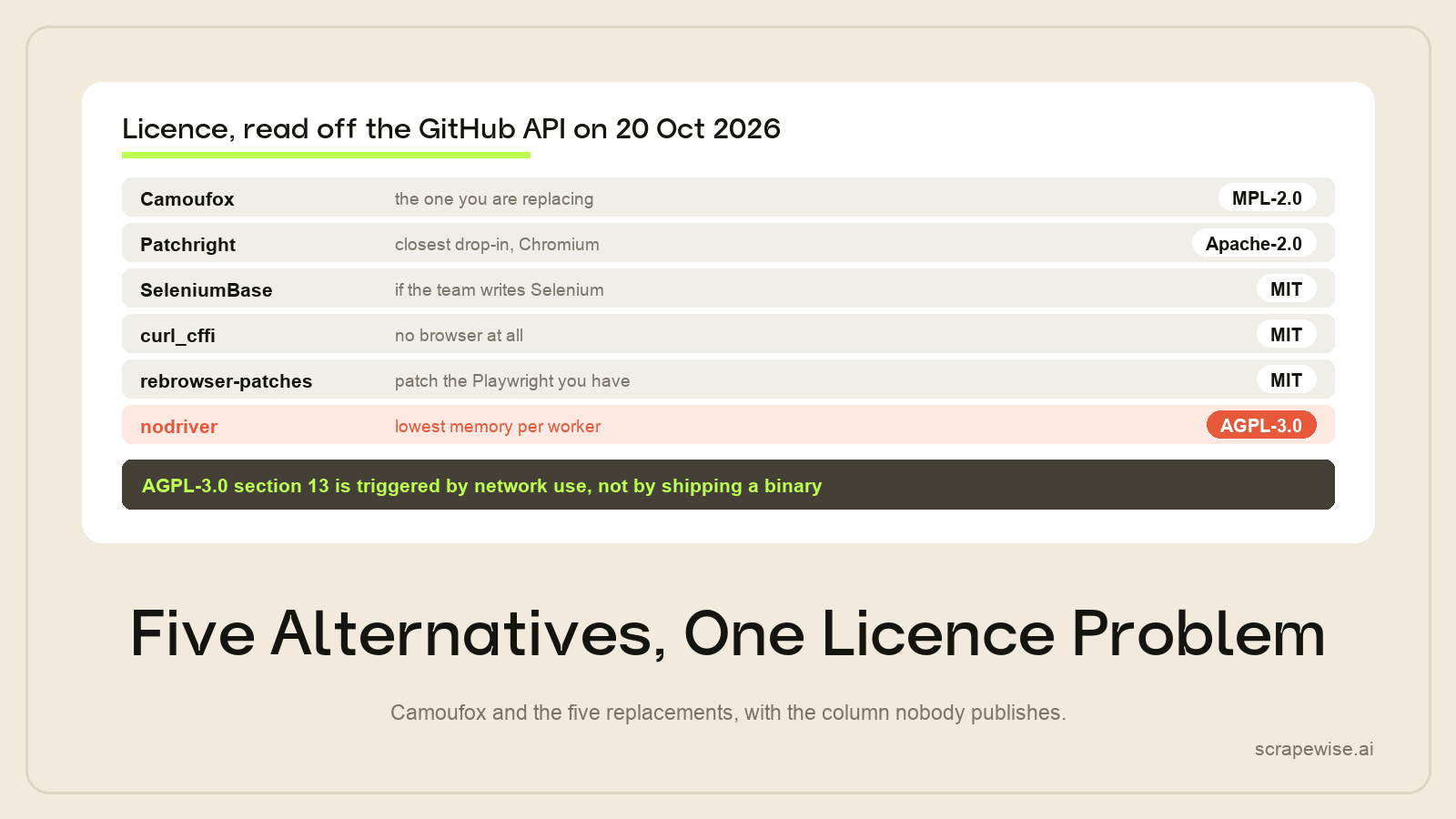
- Camoufox is MPL-2.0, Patchright Apache-2.0, SeleniumBase MIT, curl_cffi MIT, rebrowser-patches MIT. Checked on each GitHub repository in November 2026.
- The fastest alternative is not a browser. On Akamai, which reads the TLS handshake first, a TLS-impersonating HTTP client is often the better tool, at a fraction of the compute.
- Camoufox is still a strong answer on Cloudflare Enterprise, where its engine-level Firefox patches matter most. It wins where it wins; it is not a default.
Hardly anyone leaves Camoufox because it fails to get in. They leave because of what it costs per page to get in — slow challenge pages, a full Firefox per context, and a fleet that has to grow linearly with the catalogue.
So an honest alternatives list is not a stealth leaderboard. It is a list sorted by the constraint that is actually binding on you, and for most teams that is throughput or licensing, not detection.
Choose Before You Read
| Your reason for looking | Go to |
|---|---|
| Camoufox works but the crawl does not finish in time | Throughput is the number |
| Legal asked what licence your scraper stack uses | The licence axis |
| You are on Node.js and Camoufox is Python-first | Patchright |
| The target is Akamai, not Cloudflare | Drop the browser entirely |
| You want the lowest memory per worker | nodriver — then read the licence section |
| You are not sure you should replace it at all | Camoufox is still right for |
Why People Leave Camoufox (It Is Rarely Stealth)
Camoufox is a Firefox fork with anti-detection patches applied at the C++ engine level rather than injected as JavaScript after the page loads. That design is the reason it scores well — there is no patched property descriptor for a detection script to notice, because the behaviour was changed before the runtime existed.
Engine-level patching matters most against Cloudflare's JavaScript challenges. Camoufox is also one of the heaviest tools in this list. The three complaints that actually drive replacement:
- Slow challenge pages. A full browser has to load, render and run the challenge, so pages per hour per worker are low
- Memory per browser context. The Camoufox README itself puts it at about 200MB, so concurrency is bounded by RAM long before it is bounded by the target. Its README also warns that "Camoufox has gone down in performance due to the base Firefox version" (checked Nov 2026)
- A separate patched Firefox binary to download and pin, which is a different operational story from
pip install
None of those is a stealth failure. They are capacity facts, and they only matter at volume — which is exactly where price monitoring lives.
The Five Alternatives, With Their Licences
Licences checked on each project's GitHub repository in November 2026. Licences rarely change, and the licence is the column that turns out to matter.
| Tool | Licence | Replaces Camoufox when |
|---|---|---|
| Patchright | Apache-2.0 | You need Chromium, Node.js, or speed |
| SeleniumBase | MIT | You want UC mode plus a test framework |
| nodriver | AGPL-3.0 | Memory per worker is the binding limit |
| curl_cffi | MIT | The data is in the HTML — no browser needed |
| rebrowser-patches | MIT | You want to keep Playwright and patch its leaks |
| Camoufox (the incumbent) | MPL-2.0 | — |
1. SeleniumBase (MIT)
The most under-rated option on the list, because people file it as a testing framework and stop reading. Its UC mode drives a real Chrome with the automation markers removed, and it clears interactive widgets that a vanilla driver cannot touch. If your team already writes Selenium, this is the shortest path from blocked to unblocked.
Weakest on the hardest tier: Cloudflare Enterprise and DataDome can still block it on targets where an engine-patched browser gets through.
2. Patchright (Apache-2.0)
A patched Chromium that is a drop-in for Playwright — in practice one import line. Against Camoufox you give up the Firefox-shaped fingerprint and engine-level patching, and get back a faster browser, Chromium instead of Firefox, and Node.js support.
That trade is usually correct below Enterprise tier. Full detail in Camoufox vs Patchright and what Patchright actually patches.
3. nodriver (AGPL-3.0)
The lightest of the browser options, because it drives unmodified Chrome over the DevTools Protocol with no framework in between and never fires the Runtime.enable call that detection systems watch for.
It is also the one that does nothing about behavioural scoring, so Cloudflare Enterprise, DataDome and Akamai still block it. See nodriver vs Playwright for where that ceiling sits.
And it is AGPL-3.0. Read the next section before you adopt it.
4. curl_cffi (MIT)
Not a browser at all. It replays a real browser's TLS handshake at the socket level, which on some vendors is the only signal that matters. On Akamai Bot Manager, which reads the TLS handshake first, it is often the better tool, at a fraction of the compute, because there is no browser process.
On Cloudflare it is weaker than a stealth browser, because it cannot run JavaScript challenges, so this is a per-vendor choice, not an upgrade. The mechanics are in curl_cffi and TLS fingerprint impersonation and the Akamai inversion is in Playwright vs Akamai Bot Manager.
5. rebrowser-patches (MIT)
The conservative option: keep Playwright or Puppeteer and patch the known CDP leaks rather than adopt a new runtime. Smallest migration cost on this list and the smallest gain. Sensible when you have a large existing Playwright codebase and a detection problem that is narrower than it feels.
The Licence Axis Nobody Puts in These Lists
Every roundup of Camoufox alternatives ranks on stealth and speed. We have not found one that prints the licence column, and it is the column most likely to get a decision reversed after the fact.
AGPL-3.0 — nodriver's licence — extends copyleft to network use. Where a normal GPL obligation is triggered by distributing a binary, the AGPL's section 13 is triggered by letting users interact with the software over a network. If scraped data reaches your customers through a product that embeds it, whether that creates an obligation is a real question with a real answer, and the answer is your counsel's to give, not a blog's.
MPL-2.0 — Camoufox's licence — is file-level copyleft. Modify Camoufox's own files and those files stay open; your surrounding code does not. This is why Camoufox is generally unproblematic inside commercial products.
Apache-2.0 and MIT — Patchright, SeleniumBase, curl_cffi, rebrowser-patches — are permissive. Apache-2.0 additionally grants a patent licence, which some legal teams specifically ask for.
None of this is legal advice and we are not qualified to give it. The point is narrower and worth saying plainly: of the five alternatives, exactly one has a licence that can turn an infrastructure choice into a product decision, and it is routinely recommended without that being mentioned. Check it before you build on it, not after.
Throughput Is the Number That Decides
If you are replacing Camoufox for capacity rather than access, this is the arithmetic to run.
| Camoufox | Patchright | nodriver | curl_cffi | |
|---|---|---|---|---|
| Runs a full browser | Yes (patched Firefox) | Yes (patched Chromium) | Yes (unmodified Chrome) | No |
| Memory per worker | About 200MB (per its README) | A full Chromium | A full Chrome, no framework layer | Negligible |
| Can run JavaScript challenges | Yes | Yes | Yes, with weaker stealth | No |
Work it from the brief, not the tool. Four competitors, 5,000 SKUs, daily, is 20,000 pages. If a fifth of those hit a challenge, that is 4,000 challenges a day. Divide by how many challenges one worker clears per hour on your own target, and you have your worker-hours. On a cheaper tool that passes less often you will run more retries; on a heavier one you will run more workers. Both end up as a line on an invoice.
The configuration most teams land on is not a single tool at all: route per domain. Cheapest approach by default, measure block rate per target rather than site-wide, promote only the failing handful to the heavy browser with its own concurrency cap. A low site-wide failure figure often hides one domain failing most of the time while the rest sit near zero.
Camoufox Is Still Right For
Worth stating, because "alternatives" articles tend to conclude that you should switch:
- Cloudflare Enterprise targets. Engine-level patching is what this tier tends to reward, and every failed page is a retry.
- High-value, low-frequency pages. If you need a few hundred pages a day from a hard target, a slow browser per page is fine and nobody notices.
- Firefox-shaped fingerprints specifically. The whole reason it wins on Cloudflare is that it is not in the Chromium family.
- Commercial products with a careful legal review. MPL-2.0 is the easiest licence on this list to live with after AGPL is ruled out.
Switching away from the tool that gets through because it is slow, then discovering the replacement needs three retries per page, is a round trip a lot of teams have made.
What None of Them Replace
All six tools here hand you a way to fetch a page. None hands you data.
What stays yours regardless of the choice: writing selectors and rewriting them after every redesign, buying and rotating proxies, session and cookie management, retry logic, storage, change detection, and the matching layer that turns rows from six retailers into one comparable table. The fetching tool is the part of this problem that attracts the most attention and consumes the least ongoing time.
If what you want is competitor prices and stock levels arriving in your systems rather than a browser fleet to keep alive, the Camoufox-versus-everything question is the wrong one to be answering. ScrapeWise (which publishes this blog) runs the browsers, the proxies and the anti-bot escalation and delivers structured rows. It does not get through every site; some block automated visits or need a login. No plan and no compute units: a balance you top up, and a published charge per delivered page — EUR 0.15 per 1,000 for plain requests, EUR 0.75 with rendering, EUR 1.50 through the residential tier and EUR 3.75 for render plus residential. Your balance does not expire.
The honest boundary: we are a data feed, not an automation framework. Self-serve runs at most once a day on a schedule, keeps data for 90 days, and does not alert you to changes. It can match products across retailers against a product list you upload. If you are building something interactive, keep the browser and keep the library.
You can also call ready-made scraping API endpoints directly, or see how this feeds competitor price tracking.
So Which Should You Pick?
- Stay on Camoufox — Cloudflare Enterprise, high-value pages, volume you can bound.
- Patchright — you want most of the access for materially more speed, on Chromium, with Node.js available.
- SeleniumBase — your team already writes Selenium and the targets are mid-tier.
- curl_cffi — the target is Akamai, or the data is already in the HTML. The biggest cost saving on the list.
- nodriver — memory is the binding constraint and the targets are light. Settle the AGPL question first.
- rebrowser-patches — a large existing Playwright codebase you do not want to migrate.
- None of them — you want rows on a schedule and would rather not run a browser fleet to get them.
The seventh option has no memory footprint on your machines at all, because the browser fleet is not yours:
pip install scrapewise
from scrapewise import ScrapewiseClient

with ScrapewiseClient() as sw:          # reads SCRAPEWISE_API_KEY from the environment
    html = sw.load_site("https://www.example.com/product/123")
Nothing to size, nothing to pin to a Firefox version. Try it on one of your own target URLs: the first 5 requests are free, no card needed, then the per-page rates. Or compare the two incumbents head to head in Camoufox vs Playwright.
Skip the stealth setup
No fingerprints to patch and no proxies to rotate. Paste a URL and get structured data back. 5 free requests, no card.
Not ready to sign up? See 40 rows from a real Amazon search →
5 free requests no credit card · from €0.15 per 1,000 pages · or call it from Python or MCP →