
Zyte Alternatives: 6 Tools Compared
Short version: Zyte (formerly Scrapinghub) built Scrapy and is genuinely excellent at the hard half of scraping — getting an unblocked page back from a defended site. It is less good at the half most teams actually need: turning that page into rows, on a schedule, without a Python developer. Add 5 request tiers spanning $0.06 to $16.08 per 1,000 and the invoice becomes something you model rather than something you know. Below: what each realistic Zyte alternative bills you for, how much building is left afterwards, and the cases where Zyte is still the right answer.
Six Zyte Alternatives, Side by Side
| Tool | Pricing model | What you still build | Best for |
|---|---|---|---|
| ScrapeWise | €0.15 per 1,000 pages delivered | Nothing — you pick fields, rows arrive | Teams who want the data, not the pipeline |
| Zyte | Per request, 5 tiers ($0.06–$16.08 / 1,000) | Scrapy spiders, parsing, scheduling, storage | Python teams already running Scrapy at scale |
| Apify | Compute units plus actor rental | The actor, if the marketplace lacks your target | Developers who like a marketplace of components |
| Bright Data | Plan floor from $499/mo plus usage | Parsing and pipeline, unless you buy a dataset | Enterprises buying proxy scale and datasets |
| ZenRows | Monthly request quota | The parser and everything downstream | Developers who only need the unblocked HTML |
| Oxylabs | Plan-based, proxy-led | Parsing and pipeline | Teams whose real problem is proxy quality |
| Octoparse | Seat plus task tier per month | Maintenance — every layout change is your task | Non-developers doing modest, stable scrapes |
Which One Is Actually Right for You
Stay on Zyte if
You already run Scrapy spiders in production and that developer cost is sunk. Scrapy Cloud is a sensible place to host them, Smart Proxy Manager is a real asset on defended targets, and the managed Data Services tier with SLAs has no cheap equivalent. Migrating working spiders to save on request tiers is rarely worth the engineering week.
Choose ZenRows or Oxylabs if
Your only unsolved problem is getting the page back. Both are narrower than Zyte and easier to reason about on price. Neither parses for you — you are choosing a simpler connection layer, not a smaller amount of work. If you already have the parser, that is exactly the right trade.
Choose Bright Data if
You need scale and breadth more than you need a per-request rate, or the dataset you want already exists in their catalogue. Expect a plan floor around $499/mo before usage. It is the right answer for large programmes and the wrong one for a single price feed.
Choose Apify if
A well-maintained actor already exists for your exact target. Then you are renting working code rather than writing it, which is a genuinely good deal. The moment the marketplace does not have your site, you are back to building — and now in someone else's SDK, billed in compute units.
Choose ScrapeWise if
The output you want is rows, not requests. You pick the fields in a visual builder, set a schedule, and the data arrives by REST API or CSV at €0.15 per 1,000 delivered pages — plain rate, with render at €0.75 and residential at €1.50. There is no Scrapy, no request-tier modelling, and failed pages cost nothing because you pay for what comes back.
Do not choose ScrapeWise if
You need a managed data service with a contractual SLA and a named account team, or you want low-level per-request control over which proxy and which browser handled each fetch. Zyte sells both. ScrapeWise deliberately hides that layer — that is the point, and it is the wrong point if you want to tune it.
Zyte vs ScrapeWise
Why Teams Leave Zyte
Bills That Spiral Out of Control
Zyte's per-request pricing spans 5 tiers from $0.06 to $16.08 per 1,000 requests — a 268x spread that depends on which features each request uses (browser rendering, residential proxies, AI extraction). The same scraping job can land in different tiers run-to-run. Users report bills 40x higher than expected when retries, browser rendering, or premium proxies cascade. Spending caps exist but are well-documented as unreliable. Finance teams can't budget Zyte against a yearly plan because last month's invoice doesn't predict next month's.
Requires Python Developers
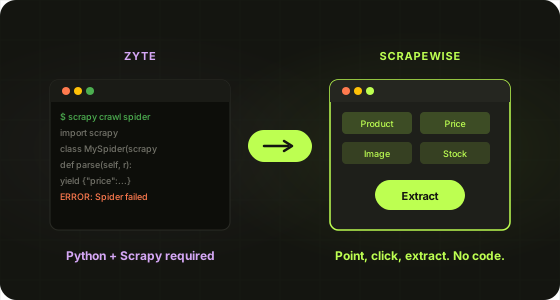
Zyte built and maintains Scrapy — the dominant Python scraping framework. That's a strength if you have a Scrapy developer; it's a barrier if you don't. Custom extraction means writing spiders, managing pipelines, debugging selectors, and deploying to Scrapy Cloud. Business teams can't build or modify scrapers without engineering support. The AI Copilot helps with selector generation, but the underlying workflow still assumes a developer in the loop.
Slow Support for Urgent Issues
Support tickets typically see 24–48 hour response windows, with weekend gaps. When a scraper breaks on a Friday afternoon — common when target sites push layout changes — the team waits until Monday for triage. For competitor monitoring or repricing workflows that depend on daily data, that's a real outage. ScrapeWise provides direct support to every customer, with response times measured in hours not days.
Same Extraction Power, Zero Scrapy
Zyte has earned its enterprise reputation. The Scrapy framework, Smart Proxy Manager, and managed Data Services are best-in-class for teams that already operate scraping as a developer-led discipline with budgets sized accordingly. The mismatch happens when a pricing manager, brand-protection lead, or e-commerce ops team inherits Zyte and tries to use it without a Scrapy developer — that's where the per-request billing model and Python requirements become friction. ScrapeWise removes both: visual builder instead of code, one published price per page instead of five request tiers, one platform instead of three separate products. Same data outputs, none of the developer dependencies.
- ✕ Need Scrapy / Python expertise for custom scrapers
- ✕ Per-request pricing across 5 confusing tiers
- ✕ Spending limits advertised but reportedly unreliable
- ✕ Support response: 24–48 hours typical, weekend gaps
- ✕ Separate products: API, Scrapy Cloud, Data Services, AI
- ✓ Visual builder, no coding required
- ✓ Pay-as-you-go pricing, published per page
- ✓ You can only spend the balance you top up
- ✓ Direct human support for every customer
- ✓ One platform for extraction, scheduling, and analytics
What 1.5 Million Pages a Month Costs
| 1.5M pages / month | Zyte | ScrapeWise |
|---|---|---|
| What you are billed for | Requests, tiered by features used | Pages actually delivered |
| Published rate | $0.06–$16.08 per 1,000 — a 268x spread | €0.15 per 1,000 plain, one rate |
| 1.5M plain pages | Depends which tier each request landed in | €225 |
| Pages needing JavaScript | Browser API, billed separately | €0.75 per 1,000 — published |
| Pages needing residential IPs | Top tier — where the 40x invoices come from | €1.50 per 1,000 — published |
| A run that fails halfway | Requests made are requests billed | Undelivered pages cost nothing |
| Predicting next month's invoice | Model the expected request mix | Pages × rate. That is the whole model |
| Unused balance at month end | N/A — usage-billed after the fact | Carries over. It never expires |
Pricing Comparison
Zyte
- - Per-request billing across 5 pricing tiers
- - $0.06 to $16.08 per 1,000 requests — 268x cost spread
- - Browser rendering and AI extraction billed separately
- - Managed data services: from $450/mo with SLAs
- - Spending limits reported as unreliable in user reviews
- - $5 free credit on signup, no permanent free tier
- - Annual budgeting requires modelling expected request mix
Scrapewise
- ✓ Pay-as-you-go: no monthly plan, no quota
- ✓ Plain pages: €0.15 per 1,000 (€0.00015 per page)
- ✓ Render: €0.75 per 1,000 · Super (residential proxy): €1.50 per 1,000
- ✓ You only pay for pages that are delivered
- ✓ Six published prices, not five opaque request tiers
- ✓ 5 free requests on every new account
- ✓ No project, task or seat limits — your balance is the only limit
Moving Off Zyte
List what each spider actually returns
Open the item definitions, not the parsing code. The set of fields you ship downstream is usually much smaller than the spider suggests — often price, stock, title, URL and a timestamp. That list is what you rebuild; the selector logic is not.
Pull a month of Zyte invoices apart
Split requests by tier. The plain-tier share is what moves to €0.15 per 1,000, the rendered share to €0.75, the residential share to €1.50. This is also where most teams discover how much they were paying for retries.
Rebuild the highest-volume target first
Pick the spider that costs the most, point the visual builder at one of its pages, and select the fields from step one. Run it against the 5 free requests. If it works on your worst site, the rest are easier.
Reconcile against a Scrapy Cloud export
Run both for a week and diff the feeds row by row. Where they disagree, one of them is reading a variant, a promo price, or a stale cache. Resolve every difference before you cut over — this is the step teams skip and regret.
Move the schedule off Scrapy Cloud
Set the cadence in ScrapeWise and point your warehouse at the REST API or the CSV export. At this point the Scrapy Cloud jobs are duplicate work, not insurance.
Retire the spiders and the deploy pipeline
Delete the jobs, then the CI that deployed them. The maintenance burden you are actually removing is not the code — it is the person who gets paged when a layout changes.
Web Scraping Without Surprise Bills
ScrapeWise gives you Zyte-level extraction without Python, without opaque request tiers, and without bills that spiral past your budget. Same data, one platform, one published price per page.
Frequently Asked Questions
Common questions when comparing Zyte and ScrapeWise.
It depends on which half of Zyte you are replacing. If you only need the unblocked page, ZenRows and Oxylabs are simpler and easier to price. If you need scale and breadth, Bright Data. If a marketplace actor already exists for your target, Apify. If what you actually want is rows rather than requests — no Scrapy, no request-tier modelling — ScrapeWise, at €0.15 per 1,000 delivered pages with 36 ready-made endpoints for common sources.
Don't take the table's word for it
Every ScrapeWise data API page ships a real sample table you can read on the page and download as CSV — no account, no card, no email.
Switching from Zyte and want it walked through? Book a 15-min call →