
Apify Alternatives: 6 Tools Compared
Short version: Apify is excellent when a well-maintained actor already exists for your exact target. When it does not, you are writing one in JavaScript and paying Compute Units to run it. ScrapeWise delivers pages at €0.15 per 1,000 with no plan, no compute units and no actor to fork. Six alternatives compared below — including where ScrapeWise is the wrong answer.
Apify Alternatives and Competitors at a Glance
Six alternatives, plus Apify itself as the baseline. The column that decides most switches is the third one: what happens on the day the marketplace does not have your target.
| Tool | Pricing model | What you still build | Best for |
|---|---|---|---|
| ScrapeWise | Pay-as-you-go, €0.15 per 1,000 delivered pages | Nothing — validated rows arrive | Price and product data on a schedule, run by business teams |
| Apify | Compute units plus per-actor rental and per-result fees | Actor selection, orchestration, glue code — or a new actor | Developers who want a marketplace and an SDK |
| Zyte | Per 1,000 requests | Extraction schema and the pipeline around it | Scrapy teams that want anti-bot inside the API |
| Bright Data | Per GB of bandwidth, billed per product | Scraper logic, extraction schema, monitoring | Petabyte-scale enterprise across many data types |
| ZenRows | Monthly request quota | The whole extraction layer | Developers who need an anti-bot API, not data |
| Octoparse | Seat plus task tier, per month | The point-and-click config, and its upkeep | Analysts who want to build and own the scraper |
| Browse AI | Credits per robot run | Re-recording the click path when layouts move | Small, low-frequency monitoring jobs |
Which One Is Actually Right for You
Most comparison pages exist to tell you the answer is the company that wrote them. Here is the honest version, including the two cases where you should not pick us.
Stay on Apify if
A well-maintained actor already covers your target, or you have JavaScript and TypeScript engineers who are happy owning one. The SDK, Crawlee and the MCP integrations are genuinely good, and if you are building scraping into a product rather than consuming data, that is the right layer to be at.
Choose Zyte or ZenRows if
You have a working scraper and only the connection layer keeps failing. Both drop into existing code and bill per request rather than per compute second. You keep owning the schema, the retries and the alerting — which is fine if you already do.
Choose Bright Data if
You need raw proxy infrastructure across many data types and you operate at enterprise scale. It is a heavier, more expensive tool than Apify, and it is the correct one when the bottleneck is genuinely IP quality and geographic coverage.
Choose Octoparse or Browse AI if
You want to build the scraper yourself without code and the job is small and infrequent. Both are faster to a first result than writing an actor. Both hand you the maintenance when the target site redesigns, which is the part people underestimate.
Choose ScrapeWise if
You want competitor prices, stock levels and product data arriving in your systems, and you do not want a scraping stack to keep alive. No plan, no quota, no compute units — you top up a balance and pay €0.15 per 1,000 delivered pages, with 5 free requests on every new account.
Do not choose ScrapeWise if
You are building a product that has to crawl arbitrary URLs at runtime, or you want an SDK and a framework to write against. We deliver structured rows from e-commerce and marketplace sources. If you want a developer platform with a marketplace, Apify is the correct tool and we will say so.
Apify vs ScrapeWise
Why Teams Leave Apify
Costs You Can't Predict
Compute Units charge by execution time and memory, on top of per-result fees that some marketplace actors layer on. Two runs of the same actor can cost very different amounts depending on retries and target-site response times. Credits expire each month, so any unused capacity is gone. Teams trying to budget a year of scraping ahead of time end up either over-buying credits or scrambling when overage hits. ScrapeWise is pay-as-you-go: you top up a balance and pay per page delivered. Plain pages cost €0.15 per 1,000, and you only pay for pages that actually come back. Nothing expires at the end of the month, and there are no Compute Units, per-result fees, or per-actor add-ons.
Marketplace Actors Break Without Warning
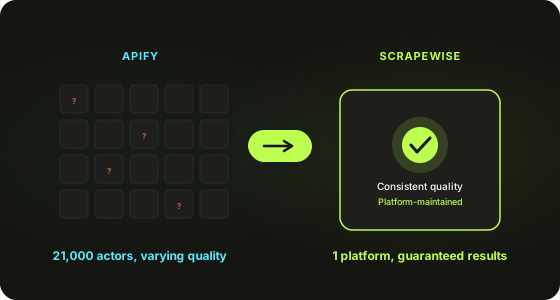
Apify's strength is its 21,000+ community-built actors. Its weakness is the same. A handful of authors maintain their actors well; many don't. When the target site changes its HTML, broken actors return empty results or errors with no escalation path beyond opening a GitHub issue and waiting. For business-critical price tracking, that's a single point of failure you don't own. ScrapeWise maintains every scraper in-house, with selector recovery built into the platform — when a target site updates its layout, your job keeps working.
Anything Custom Requires a Developer
Apify's pre-built actors cover well-known sites. Anything beyond — a regional retailer, a niche marketplace, a competitor's catalog with a custom layout — needs a developer to write a new actor in JavaScript, TypeScript, or Python using the Apify SDK. That's a sprint of engineering time you don't have. ScrapeWise's visual builder works on any public site without code: point at the data you want, name the fields, schedule, done.
When Apify Is the Right Tool, and When It Isn't
Apify is a serious developer platform actively investing in AI agents, MCP integrations, and the Crawlee framework. If your team writes scraping into a product — for example, you're building an AI search startup and you need an agent that can crawl arbitrary URLs at runtime — Apify is built for you. If your team is non-technical and you need a reliable monthly feed of competitor prices, marketplace listings, or product catalogs into a spreadsheet or your BI tool, you're not the audience Apify is optimizing for in 2026. ScrapeWise is the opposite focus: no developer required, no Compute Units to forecast, no marketplace lottery. Pick the tool that matches who's actually using it.
- ✕ Actor quality varies by community author
- ✕ CU + per-result fees = unpredictable monthly bills
- ✕ Credits expire if unused each month
- ✕ Actors break when target sites update
- ✕ Custom scrapers require JS / TS / Python
- ✓ Consistent quality, platform-maintained scrapers
- ✓ Pay-as-you-go pricing, no overage charges
- ✓ Your balance does not expire, no use-it-or-lose-it pressure
- ✓ Visual builder adapts to site changes
- ✓ No coding for any extraction task
What a 50,000-SKU Daily Crawl Actually Costs
A catalogue of 50,000 SKUs refreshed daily is 1.5 million pages a month. Compute Units and per-page billing are not directly comparable — CU consumption depends on run time, memory and how often a target site makes you retry. What is comparable is the floor you pay before a single page arrives, and what happens when a run fails halfway.
| 1.5M pages / month | Apify | ScrapeWise |
|---|---|---|
| Floor before any usage | Starter $19/mo, Scale $199/mo for teams | None — you top up a balance, no plan |
| Plain pages | Compute Units at $0.20 (Starter) or $0.16 (Scale) per CU | €0.15 per 1,000 = €225 |
| JavaScript-rendered pages | More CU per page — browser actors run longer | €0.75 per 1,000 = €1,125 |
| Residential-proxy pages | Proxy billed separately on top of CU | €1.50 per 1,000 = €2,250 |
| Marketplace actor fees | Many actors add a per-result fee on top of CU | None — no rental, no per-result charge |
| A run that fails halfway | CU already consumed is still billed | Not billed — delivered pages only |
| Unused capacity at month end | Free and included credits expire | Balance carries over, nothing expires |
| Your own catalogue and refresh rate | Apify pricing calculator | €0.15–€3.75 per 1,000 pages, one rate per tier |
Pricing Comparison
Apify
- - Free: $5/mo in platform credits (expire each month)
- - Starter: $19/mo, includes $19 of platform usage, then usage overage
- - Scale: $199/mo for teams, still consumption-based
- - Compute Units: $0.20 per CU on Starter, $0.16 on Scale, after included usage
- - Many marketplace actors layer per-result fees on top of CU cost
- - Same job can cost different amounts on different days
- - Annual budgeting requires modelling usage in advance
Scrapewise
- ✓ Pay-as-you-go: no monthly plan, no quota
- ✓ Plain pages: €0.15 per 1,000 (€0.00015 per page)
- ✓ Render: €0.75 per 1,000 · Super (residential proxy): €1.50 per 1,000
- ✓ You only pay for pages that are delivered
- ✓ No Compute Units, no per-result fees, no expiring credits
- ✓ No project, task or seat limits — your balance is the only limit
- ✓ 5 free requests on every new account
Moving Off Apify
There is nothing to port. An actor is code plus an input schema, and neither transfers to a managed feed — so a migration is really a rebuild of the extraction, typically under 30 minutes per scraper.
List the actors you actually depend on
Not everything in your account — the runs that are on a schedule and feed something downstream. Most teams find it is three to six actors, a SKU list and four or five fields: price, availability, title, URL, sometimes shipping. That list is the whole migration scope.
Check what each one really costs you
Open the run history and look at CU consumed per run, not the monthly total. Add any per-result fee the actor charges. This is the number the new bill has to beat, and it is usually higher than people remember because retries are invisible until you look.
Sort targets by what they actually need
Most e-commerce pages are plain HTML at €0.15 per 1,000. Only the ones that hide price behind JavaScript need render at €0.75, and only the ones that block datacentre IPs need residential at €1.50. Sorting the list first is what turns a vague budget into a number you can check.
Rebuild one scraper in the visual builder
Pick the actor that breaks most often — usually a community one with an unresponsive maintainer. Point the builder at a product page, select the fields, and run it against your 5 free requests. You are testing whether the output matches what the actor produces, before anything is billed.
Run both in parallel for one cycle
Keep the actor running for a week and diff the two outputs on the same SKUs. This is the step teams skip and then regret — it is also the only honest way to compare delivery rates rather than marketing claims.
Cut over and stop paying for compute
Once the diff is clean, move the remaining targets and downgrade. There is no plan to negotiate on our side — you top up a balance, and if you scrape nothing in a month you pay nothing, and what is left does not expire.
Know What You'll Pay Before You Start
Apify's developer audience is fine with usage-based billing — they can model it. Pricing managers, e-commerce ops, and brand-protection teams need a number they can defend to finance. ScrapeWise replaces Apify's marketplace lottery and Compute Unit math with a visual builder, platform-maintained scrapers, and a published price per page.
Frequently Asked Questions
Common questions when comparing Apify alternatives and competitors.
It depends on what you are replacing. If you want an anti-bot API to drop into existing scraper code, Zyte or ZenRows. If you want raw proxy infrastructure at enterprise scale, Bright Data or Oxylabs. If you want to build the scraper yourself without code, Octoparse or Browse AI. If you want the data itself — competitor prices and product records arriving as validated rows with no stack to maintain — ScrapeWise, at €0.15 per 1,000 delivered pages with no monthly plan.
Don't take the table's word for it
Every ScrapeWise data API page ships a real sample table you can read on the page and download as CSV — no account, no card, no email.
Switching from Apify and want it walked through? Book a 15-min call →