

Key takeaways
- Vanilla Playwright does not clear Akamai Bot Manager v4. A patched Chromium build (Patchright) on residential proxies gets further, but is still a browser fighting the wrong layer.
- A plain HTTP client with TLS impersonation is often the better tool on Akamai, at a fraction of the compute, because it fixes the signal Akamai checks first.
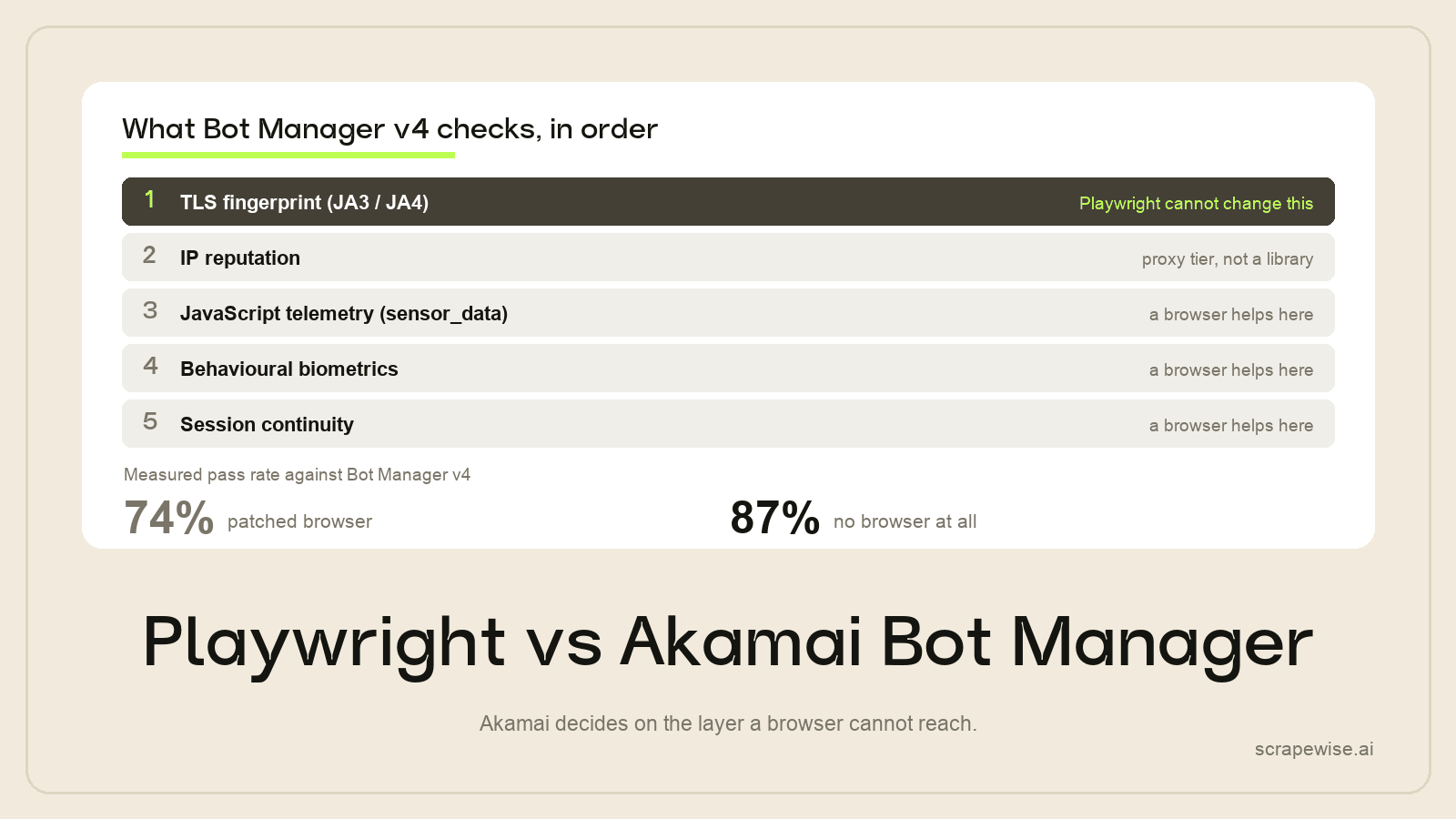
- Akamai ranks TLS fingerprinting first, which is the one signal Playwright cannot change — the handshake belongs to the Chromium build, not to your script.
- If you keep the browser, a session warm-up and human-like mouse paths matter more than which stealth library you pick.
- Keep the browser for Akamai-protected flows behind a login or a cart. Drop it for catalogue and price pages.
Vanilla Playwright does not clear Akamai Bot Manager. A patched Chromium build gets you further, and a plain HTTP client with the right TLS handshake often does better still, for a fraction of the compute.
That last part is the counter-intuitive bit, and it is specific to Akamai. On Cloudflare, a stealth browser is the right answer. On Akamai it usually is not, because the two vendors rank their signals in a different order — and the signal Akamai ranks first is the one Playwright has no control over.
Choose Before You Read
| Your situation | Do this |
|---|---|
| Playwright is blocked on an Akamai catalogue or product page | Drop the browser, fix the TLS handshake |
| The Akamai target is behind a login or a cart | Keep the browser; add warm-up and motion |
| You are on vanilla Playwright and have changed nothing yet | Switch to Patchright first — it is one import line |
| You are on datacentre proxies | Fix that before anything else; it caps every approach in the table below |
| You are not sure the WAF is Akamai | Confirm it first — the fix is different per vendor |
| You want the rows, not a stealth stack | Skip to the last section |
The Approaches Side by Side
The full per-signal breakdown is in bypassing Akamai Bot Manager; what follows is the Playwright-relevant slice. ScrapeWise publishes this blog and sells a scraping API, which is worth knowing when you read the last sections.
| Approach | Real browser TLS handshake | Runs page JavaScript | Relative compute cost |
|---|---|---|---|
| Requests library + datacentre proxies | No | No | Lowest |
| curl-cffi + datacentre proxies | Yes (impersonated) | No | Low |
| curl-cffi + residential proxies | Yes (impersonated) | No | Low |
| Camoufox + datacentre proxies | Yes (Firefox build) | Yes | High |
| Patchright + residential proxies | Closer to Chrome (patched build) | Yes | High |
| Camoufox + residential proxies | Yes (Firefox build) | Yes | Highest |
Two rows matter here. Patched Playwright on residential IPs fixes the DevTools leaks but still pays for a full browser. A socket-level HTTP client on the same IPs fixes the TLS handshake, which is what Akamai reads first, with no browser process at all.
Vanilla Playwright is not in the table because it is not an approach, it is the control. It announces itself over the DevTools Protocol and gets refused.
Why Akamai Specifically Punishes a Browser
Akamai evaluates in this order:
- TLS fingerprint (JA3/JA4) — the handshake, before a single byte of your page runs
- IP reputation — ASN, history, whether the range is a known cloud provider
- JavaScript telemetry — the
sensor_datapayload, validated server-side - Behavioural biometrics — mouse paths, scroll events, dwell time
- Session continuity — whether this "new" session behaves like one
Layer 1 is the problem. A JA3 or JA4 fingerprint is a hash of what your client offers during the TLS handshake: cipher suites, extensions, elliptic curves, the order they appear in. It is decided by the TLS library compiled into your binary, and it is read before any JavaScript executes.
Playwright cannot change it. There is no launch argument, no context option and no stealth plugin that rewrites the handshake, because the handshake is not Playwright's — it belongs to the Chromium build underneath. A patched Chromium ships a handshake closer to real Chrome, which is part of why Patchright gets further than vanilla. But "closer to real Chrome" is a fixed property of the build you installed, not a dial you turn per target.
So on a vendor that checks the handshake first, you are spending 200MB and a full page render to influence layers 3 through 5 while layer 1 decides the outcome. That is the whole asymmetry.
On Cloudflare the ordering is effectively reversed — JavaScript challenges carry more weight, which is why a stealth browser wins there and loses here.
Is It Akamai, Cloudflare or PerimeterX?
Worth thirty seconds, because the correct fix differs per vendor and people routinely apply the Cloudflare playbook to an Akamai target.
- An
_abckcookie in the response - A
sensor_dataPOST going out from the page Server: AkamaiGHostin the response headers- A
bm_szcookie, which confirms Bot Manager rather than plain Akamai CDN
If you see Turnstile or cf_clearance instead, you are on Cloudflare — different post. If you see _px cookies, it is PerimeterX, where DIY approaches hit a hard ceiling.
Among European retail, Zara, H&M, MediaMarkt and Fnac all run Akamai in front of their catalogues.
Session Warm-Up and Bezier Paths: What Actually Helped
If you are keeping the browser — and for authenticated flows you should — these did more than any library swap.
Session warm-up. Akamai's session-continuity layer scores a brand-new session that navigates straight to a high-value URL. Two or three ordinary page loads with real dwell time in between, before you touch the target, makes the session look like a visit rather than a fetch.
const { chromium } = require('patchright')

const jitter = (min, max) => new Promise(r => setTimeout(r, min + Math.random() * (max - min)))

const browser = await chromium.launch({ headless: true })
const context = await browser.newContext({ locale: 'de-DE', timezoneId: 'Europe/Berlin' })
const page = await context.newPage()

// Warm-up: land shallow, dwell, browse inward. The _abck cookie matures across these.
for (const path of ['/', '/damen', '/damen/kleider']) {
  await page.goto(`https://example-retailer.de${path}`, { waitUntil: 'domcontentloaded' })
  await jitter(1800, 4200)
}

// Only now the page you actually came for.
await page.goto(targetUrl, { waitUntil: 'domcontentloaded' })
Bezier mouse paths. A straight-line mouse.move() is a signature no human produces. Interpolating along a cubic bezier with a variable step count looks far more human than the linear default. Note what this means in practice: you are now writing and maintaining a motion simulator, which is engineering work with no end date.
And the one that is not optional: jitter, not sleep. A fixed waitForTimeout(1000) between requests is itself a fingerprint. Randomise across 300–2,500ms.
What did not help: rotating user-agent strings, overriding navigator.webdriver from JavaScript after load (detectable — a rewritten property descriptor is visible to an Object.defineProperty guard), and playwright-extra, which is effectively unmaintained and should not start new work.
When to Drop the Browser Entirely
For any Akamai page that renders its data server-side — catalogue listings, product pages, search results — the browser is pure overhead. You pay for Chromium to influence the layers Akamai weighs least, while losing on the layer it weighs most.
A client built on curl-impersonate, such as curl_cffi, replays a real browser's TLS handshake at the socket level. On a vendor that reads the handshake first, that one change is often the biggest step you can take, and residential IPs add to it. Full walkthrough: TLS fingerprint impersonation with curl_cffi.
Keep the browser when:
- The page genuinely renders client-side and the data is not in the HTML
- You are behind a login, a cart or a checkout — Akamai's session tracking is strongest here, and a browser is the realistic way to hold a session
- You need to interact: a size selector, a store-availability lookup, a "load more" button
Drop it when the markup already contains what you came for. Checking takes one request.
What This Costs to Keep Alive
These are rough planning estimates, not measurements:
| Approach | Monthly infra at 10k pages/day | Engineering maintenance |
|---|---|---|
| curl-cffi + residential proxies | ~$120–180 | 3–5 hrs/month |
| Patchright + residential proxies | ~$380–520 | 8–12 hrs/month |
| Camoufox + residential proxies | ~$440–600 | 10–15 hrs/month |
The maintenance column is the one that gets underestimated. Akamai changes its sensor script from time to time, and a change can break a working setup overnight. Your scraper does not break loudly; it starts returning fewer rows, and somebody notices a week later in a report.
When Stealth Stops Being a Library Decision
The honest arc of an Akamai project is: vanilla Playwright blocked → Patchright passes → volume rises → rate-limited → residential proxies added → behavioural scoring catches the timing → you are writing a mouse-movement simulator. Step six is where teams discover this was never a library choice.
If what you need is competitor prices, stock levels and product data arriving in your systems rather than a stealth stack to keep alive, the Playwright-versus-Akamai question is the wrong one to be answering. ScrapeWise runs the browsers, the proxies and the challenge handling and delivers structured rows. It does not get through every site; some block automated visits outright or need a login. No plan and no compute units: a balance you top up, and a published charge per delivered page — EUR 0.15 per 1,000 for plain requests, EUR 0.75 with rendering, EUR 1.50 through the residential tier and EUR 3.75 for render plus residential. Your balance does not expire. To see whether your Akamai targets are ones it can reach, run a few of their URLs through ScrapeWise: the first 5 requests are free, no card needed.
You can also call ready-made scraping API endpoints directly, or see how this feeds competitor price tracking.
So What Should You Run?
- Patched Playwright, warmed up, with motion — the Akamai target is behind a login or a cart and you need to hold a session.
- An HTTP client with TLS impersonation — the data is in the HTML. It fixes the layer Akamai reads first, at a fraction of the compute.
- Camoufox — high-value, low-frequency pages where a slow, heavy browser per page is acceptable. Its edge is on Cloudflare, not on Akamai.
- Vanilla Playwright — tests, and targets with no WAF. Never this one against Bot Manager.
- None of the above — you want delivered rows on a schedule and would rather not maintain any of it.
Paste a URL that blocks your scraper
ScrapeWise picks the route (plain request, browser or residential proxy) and returns clean data. 5 free requests, no card.
Not ready to sign up? See 12 real Amazon rows, 972 columns →
5 free requests no credit card · from €0.15 per 1,000 pages · or call it from Python or MCP →