
Kadoa Alternatives: 6 Tools Compared
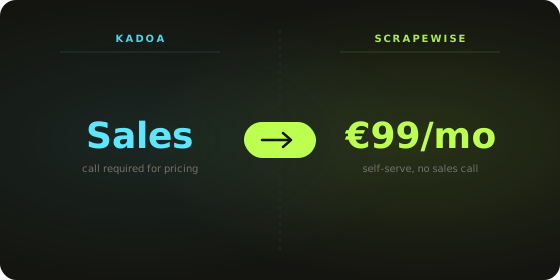
Short version: Kadoa's AI extraction is real technology, but you cannot find out what it costs without booking a call, and the product is aimed at finance and procurement rather than retail pricing. Below: what each realistic Kadoa alternative bills you for, how quickly you can actually start, and the cases where staying with Kadoa is the right call.
Six Kadoa Alternatives, Side by Side
| Tool | Pricing model | How you get started | Best for |
|---|---|---|---|
| ScrapeWise | €0.15 per 1,000 plain pages delivered | Sign up, 5 free requests, minutes | E-commerce and pricing teams who want a rate card |
| Kadoa | Quoted — no public rate card | Book a demo, wait for a quote | Finance and procurement workflows with a budget cycle |
| Apify | Platform fee plus per-actor rental and compute | Self-serve signup | Developer teams running their own code |
| Zyte | Five request tiers, $0.06–$16.08 per 1,000 | Self-serve, $5 signup credit | Engineering teams comfortable modelling a request mix |
| Bright Data | Per-GB proxy plus dataset fees | Self-serve, with KYC on some products | Large proxy-heavy operations |
| Octoparse | Seat plus cloud credits | Self-serve signup | No-code point-and-click with scheduling |
| Browse AI | Credits per robot run | Self-serve, 50 free credits/mo | Sheets-first capture on stable sites |
Which One Actually Fits
Stay on Kadoa if
Your data lives in filings, contracts, supplier documents and procurement portals rather than retail product pages, and you have a procurement process that expects a quote and an MSA anyway. That is the buyer the product is built for.
Move if the sales cycle is the blocker
The tell is wanting to test something this week. A demo, a qualification call and a quote is days before you see a single row. If you need to know whether the data is usable before you can justify a budget, gated access is a dead end.
Move if you cannot model the cost
A quoted price is fine once. It is harder when you need to answer "what does adding ten more competitors cost?" in a planning meeting. A published per-page rate makes that a multiplication rather than another call.
Move if your targets are retail
Regional retailers, marketplaces and distributor catalogues are a different problem shape from financial documents. Pick a tool whose examples look like your sites, not one where retail is an adjacent use case.
Pick a developer platform if
You want to write and version your own extraction logic rather than describe a schema. Apify and Zyte are built for that, both self-serve, and neither requires a conversation before you can benchmark them.
Do not choose ScrapeWise if
You need extraction from PDFs, filings and unstructured documents rather than web pages, or you specifically want a vendor that will sign an enterprise agreement and own a bespoke integration. ScrapeWise is a self-serve rate card, not a services engagement.
Kadoa vs ScrapeWise
Why Teams Look Beyond Kadoa
You Cannot Evaluate What You Cannot Price
There is no public rate card, so the first step is a call and the second is a quote. That is a reasonable model for a six-figure enterprise deal and a poor one for a team that wants to know by Thursday whether the data is good enough to build on. Most evaluations die in the gap.
A Quote Is Not a Cost Model
Once you have a number, you still cannot answer the planning question: what does the eleventh competitor cost, or doubling the check frequency? A published per-page rate turns that into arithmetic anyone in the room can do. A negotiated contract turns it into another conversation with the vendor.
Built Around Finance, Not Retail Pricing
Kadoa's centre of gravity is filings, supplier documents and procurement data. If your job is matching your SKUs to competitor listings across regional retailers and watching prices move overnight, you are an adjacent use case rather than the intended one — and adjacent use cases get the least attention in a roadmap.
AI-Inferred Schemas Need Someone to Check Them
Inference is excellent on shapes the model knows well and quietly wrong on niche retail markup. Self-healing selectors keep the job running; they do not tell you which rows came back wrong. Someone still has to hold a verdict on output quality, and that someone works for you.
Extraction Is Not Monitoring
Pulling structured data once and tracking it every day are different products. Monitoring needs history, change detection and alerting layered on top of extraction, and those layers are where most of the ongoing value sits.
Retail Sites Are Adversarial
Document and finance sources rarely fight back. Retail sites do — bot walls, geo-dependent pricing, variant pages that look identical and are not. That is the hardest case for a general extraction layer, and it is the only case that matters here.
A Rate Card Beats a Quote for Evaluation
Kadoa is building genuinely interesting technology for AI-driven extraction, and for document-heavy enterprise data it may well be the right answer. But for an e-commerce team that needs to start monitoring competitors this week, a published price and a signup button remove every step between the decision and the data.
- ✕ No public pricing — book a call to find out
- ✕ Demo and qualification before access
- ✕ Finance and procurement focus
- ✕ Cost of a new target depends on the contract
- ✕ Annual commitment is the norm
- ✓ €0.15 per 1,000 plain pages, published
- ✓ Self-serve signup, first rows in minutes
- ✓ Built for e-commerce and pricing teams
- ✓ Adding a target is pages × rate
- ✓ Top up from €5, balance never expires
What 300,000 Pages a Month Costs
| 20 competitors · 500 SKUs · daily | Kadoa | ScrapeWise |
|---|---|---|
| Pages fetched per month | 300,000 | 300,000 |
| What you can work out before signing | Nothing — pricing is quoted | €45 at €0.15 per 1,000 |
| Time to first row | Demo, qualification, quote, contract | Minutes after signup |
| Adding a 21st competitor | Check the contract, possibly renegotiate | +15,000 pages. Nothing else changes |
| Doubling check frequency | Depends on the commercial terms | Doubles pages. Same rate |
| Predicting next month's invoice | Ask the account manager | Pages × rate |
| Minimum commitment | Annual contract typical | €5 top-up |
| A page does not come back | Depends on the contract | Not billed |
Pricing Comparison
Kadoa
- - No public pricing available
- - Enterprise sales model — demo required
- - No self-serve free trial
- - Pricing disclosed only after sales qualification
- - Annual contracts are the norm for this shape of vendor
- - Contact sales to get started
Scrapewise
- ✓ Pay-as-you-go: no monthly plan, no quota
- ✓ Plain pages: €0.15 per 1,000 (€0.00015 per page)
- ✓ Render: €0.75 per 1,000 · Super (residential proxy): €1.50 per 1,000
- ✓ You only pay for pages that are delivered
- ✓ All pricing public — no sales conversation required
- ✓ 5 free requests on signup · top up from €5 · balance never expires
Moving Off Kadoa
1. Separate documents from web pages
Kadoa accounts usually mix two jobs: pulling structure out of filings and documents, and fetching live web pages. Only the second half is a like-for-like migration. Be explicit about which sources fall on which side before you plan anything.
2. Export the schemas you rely on
For each active extraction, write down the fields that reach a decision — not everything the model produces. That short list is the contract to reproduce, and shorter schemas migrate faster and break less often.
3. Read the contract before you plan a date
Quoted vendors usually mean annual terms and a notice period. Find the renewal date first; it determines whether this is a parallel-run migration or a hard cutover, and it is cheaper to discover now than in month eleven.
4. Check the 36 ready-made endpoints first
If your sources are common marketplaces or retailers, an endpoint may already cover them and there is nothing to configure. Free requests are enough to confirm the output shape matches before any spend.
5. Run both in parallel for two weeks
Keep the existing extractions live and run the new job alongside. Diff the outputs daily and log every discrepancy. Two weeks is the right window here rather than one — quoted-vendor migrations tend to surface edge cases in the second week.
6. Switch to arithmetic instead of renewals
Once the diff is clean, the recurring commercial decision disappears. There is no plan to pick and no renewal to negotiate: you top up from €5, pay per page delivered, and the balance carries forward.
No Sales Demo. No Waiting. Just Start.
ScrapeWise gives e-commerce and pricing teams the scraping infrastructure they need today — 5 free requests, a published per-page rate, and no enterprise sales process between you and the first row.
Frequently Asked Questions
Common questions when comparing Kadoa and its alternatives.
For retail price and catalogue monitoring with a published rate, ScrapeWise fits — €0.15 per 1,000 plain pages delivered, self-serve, 5 free requests. For teams that want to run their own extraction code, Apify or Zyte. For no-code recording, Octoparse or Browse AI. The deciding factor is usually whether your sources are documents or web pages.
Don't take the table's word for it
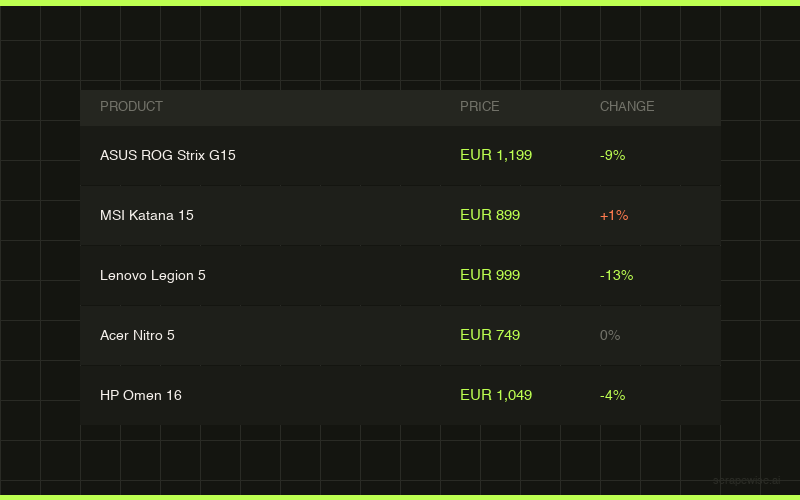
Every ScrapeWise data API page ships a real sample table you can read on the page and download as CSV — no account, no card, no email.
Switching from Kadoa and want it walked through? Book a 15-min call →