
ParseHub Alternatives: 6 Tools Compared
Short version: ParseHub was a genuine pioneer in 2014 and the visual builder still works on simple, static targets. Two things have changed since. The web moved to JavaScript-rendered storefronts that an older browser engine reads unreliably, and the category moved to the cloud — while ParseHub remains a desktop app, which means the scrape runs when the machine is on and someone is watching. At $189/mo for the Standard tier with no analytics included, the price-to-value question answers itself for most teams. Below: what each realistic ParseHub alternative bills you for, who maintains it, and when staying put is still correct.
Six ParseHub Alternatives, Side by Side
| Tool | Pricing model | Where it runs | Best for |
|---|---|---|---|
| ScrapeWise | €0.15 per 1,000 pages delivered | Cloud — rows arrive on a schedule | Teams who want the data, not the workflow |
| ParseHub | $189/mo Standard, page and project limits | Desktop app, cloud runs gated by plan | Solo researchers with simple static targets |
| Octoparse | Seat plus cloud credit packs | Desktop app with cloud add-on | Non-developers with stable, templated targets |
| Browse AI | Credits per robot run | Cloud, recorded in the browser | Recording a simple click path fast |
| Web Scraper | Free extension, cloud credits per page | Browser extension or their cloud | Developers comfortable writing sitemaps |
| Hexomatic | Credits plus premium automation steps | Cloud workflow builder | Chaining scraping into wider automations |
| Apify | Compute units plus actor rental | Cloud, developer platform | Developers who want a component marketplace |
Which One Is Actually Right for You
Stay on ParseHub if
Your targets render server-side, your projects fit inside the free tier, and you run them by hand when you need them. For genuinely static HTML and occasional research, the desktop builder is fine and the free plan costs nothing. The case for staying weakens the moment you need a nightly run.
Choose Octoparse if
You want the same visual model with a template library and an easier path to cloud runs. It is the closest like-for-like swap. Be clear-eyed about what you are buying: a seat plus a separate credit pool, and the same maintenance burden when a site redesigns.
Choose Browse AI or Web Scraper if
The job is small and you want it cheap. Browse AI records a click path in minutes; Web Scraper's extension is free for local runs. Both are excellent for a one-off and awkward for a catalogue — the robot or sitemap is yours to re-record when the layout moves.
Choose Hexomatic or Apify if
You need more than extraction. Hexomatic chains scraping into a broader automation; Apify gives developers a marketplace of ready actors and an SDK when one does not exist. Both are a step up in capability and a step up in what you maintain.
Choose ScrapeWise if
You want the output rather than the tool. Pick the fields once, set a schedule, and rows arrive by REST API or CSV at €0.15 per 1,000 delivered pages — €0.75 for rendered pages, €1.50 for residential. Nothing installs, JavaScript rendering is available to everyone, and 36 ready-made endpoints cover common sources with no builder step at all.
Do not choose ScrapeWise if
You want a free tool for an occasional one-off scrape and never intend to run it again. ParseHub's free tier and Web Scraper's extension are better answers for that. ScrapeWise makes sense when data arrives repeatedly and someone downstream depends on it.
ParseHub vs ScrapeWise
Why Teams Move On from ParseHub
A Desktop App from a Different Era
Compared with other low-code scraping tools, ParseHub is a desktop point-and-click app with paid plans from $189 a month, while Octoparse adds cloud extraction from $69 a month and Browse AI runs in the browser. ParseHub requires downloading and installing a desktop application on every machine that needs to build or run scrapers. For a category that has moved entirely to browser-native platforms over the past 5 years, this is a friction point that compounds: IT approval for each install, version updates managed manually, no access from anywhere except the configured machine, no native team collaboration. ScrapeWise runs entirely in the browser: one URL, any device, current version always.
Expensive for What You Get
ParseHub's Standard plan is $189/mo with limits on pages per run and number of projects. There are no analytics included, so exports go to Excel for any analysis. For a product that hasn't seen significant architectural updates in close to a decade, the price-to-value ratio is hard to justify against modern alternatives. ScrapeWise is pay-as-you-go instead: plain pages are €0.15 per 1,000, so 25,000 pages a month costs €3.75, with built-in data grid analytics, JS rendering, scheduling, and API access included.
Struggles With Modern JavaScript-Heavy Sites
ParseHub was built when most product pages rendered server-side and JavaScript frameworks were less common. Today's e-commerce sites — Shopify Plus storefronts, Magento 2 commerce, custom React applications, anything with infinite scroll or dynamically loaded pricing — push the limits of what ParseHub's older browser engine can handle reliably. Users report inconsistent extraction on these sites, missing variants, and pagination issues. ScrapeWise uses modern headless browser infrastructure designed for current SPAs.
Scraping That's Kept Pace With the Web
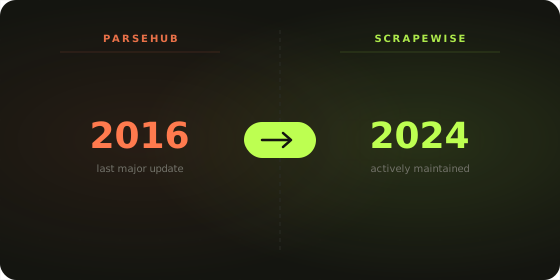
ParseHub was a genuine pioneer when no-code scraping was a new category in 2014. The desktop visual builder was a real step forward. The web has changed substantially since: most product pages, pricing tables, and competitor sites now require full JavaScript rendering, dynamic content handling, and modern anti-bot evasion that older architectures weren't designed for. For teams with simple, static-HTML targets and no team-collaboration needs, ParseHub still works. For everything else, the cleaner move is a platform built for today's web.
- ✕ Install and update a desktop application per machine
- ✕ $189/mo Standard plan with limited runs and projects
- ✕ Struggles with modern JavaScript-heavy sites
- ✕ No analytics — export to Excel and pivot elsewhere
- ✕ Limited architectural updates since 2016
- ✓ Browser-native — nothing to install, any device
- ✓ 5 free requests to start, then €0.15 per 1,000 plain pages
- ✓ Full JavaScript rendering available to everyone
- ✓ Built-in data grid analytics (filter, sort, group, pivot)
- ✓ Actively developed platform, current with the modern web
What 1.5 Million Pages a Month Costs
| 1.5M pages / month | ParseHub | ScrapeWise |
|---|---|---|
| What you are billed for | A monthly plan with page and project caps | Pages actually delivered |
| Published floor | Free: 200 pages per run · Standard: $189/mo | No plan. €0.15 per 1,000 plain pages |
| 1.5M plain pages | Standard caps at 10,000 pages per run — Professional or above | €225 |
| Pages needing JavaScript | Older engine — dynamic content is often missed | €0.75 per 1,000 — published |
| A run that fails halfway | Run consumed either way | Undelivered pages cost nothing |
| Running it every night | Desktop runs need the machine on; cloud runs are plan-gated | Scheduled in the cloud, included |
| Adding a second person | Single-user model — share configs by hand | Included — no upgrade |
| Unused capacity at month end | Plan is spent | Balance carries — it never expires |
Pricing Comparison
ParseHub
- - Free: 200 pages/run, 5 projects, no scheduling, local runs only
- - Standard: $189/mo for 10,000 pages/run, 20 private projects
- - Professional: $599/mo for higher limits
- - Enterprise: custom pricing
- - No built-in analytics on any plan
- - Desktop app required, version-managed per machine
- - 14-day free trial on paid plans
Scrapewise
- ✓ Pay-as-you-go: no monthly plan, no quota
- ✓ Plain pages: €0.15 per 1,000 (€0.00015 per page)
- ✓ Render: €0.75 per 1,000 · Super (residential proxy): €1.50 per 1,000
- ✓ You only pay for pages that are delivered
- ✓ Built-in data grid analytics and API included for everyone
- ✓ Browser-native — no install, always current
- ✓ 5 free requests on every new account
Moving Off ParseHub
Export the project list and its URLs
Each ParseHub project points at a set of pages and returns a set of fields. Write both down. The selection steps you clicked through are a re-implementation of the site as it was, not something worth carrying forward.
Count the real page volume
URLs × how often you actually need them = pages per month. That is what you will pay on. Teams on the free tier usually discover they have been running far less often than the work needed, because 200 pages per run was the ceiling.
Check the 36 ready-made endpoints first
Before rebuilding anything, see whether your source is already covered. If it is, there is no builder step — you call the endpoint and rows come back, rendered pages included.
Rebuild the project that breaks most
Pick the JavaScript-heavy target ParseHub reads unreliably. Point the visual builder at one of its pages, select the fields from step one, and run it against the 5 free requests. If it handles your worst site, the rest follow.
Reconcile against a ParseHub export
Run both for a week and diff them. On dynamic pages the differences are usually missing variants or a price that loaded after ParseHub finished reading. Resolve each one before cutting over.
Move the schedule off your laptop
Set the cadence in ScrapeWise and point your reports at the REST API or scheduled CSV. Then uninstall the desktop app. The real change is that the scrape no longer depends on a machine being awake.
Modern Scraping Infrastructure. No 2016 Price Tag.
Replace ParseHub's desktop-first workflow with a browser-native platform that handles today's JavaScript-heavy websites, includes analytics in-platform, and bills per page delivered. Start with 5 free requests, then pay only for the pages you get.
Frequently Asked Questions
Common questions when comparing ParseHub and ScrapeWise.
It depends on why you are leaving. For the closest like-for-like visual builder with a template library, Octoparse. For a fast one-off, Browse AI or the free Web Scraper extension. For developers with a marketplace actor available, Apify. If the problem is that ParseHub cannot read modern JavaScript storefronts reliably, or that the scrape only runs when your laptop is open, ScrapeWise — cloud-scheduled, JS rendering for everyone, €0.15 per 1,000 delivered pages.
Don't take the table's word for it
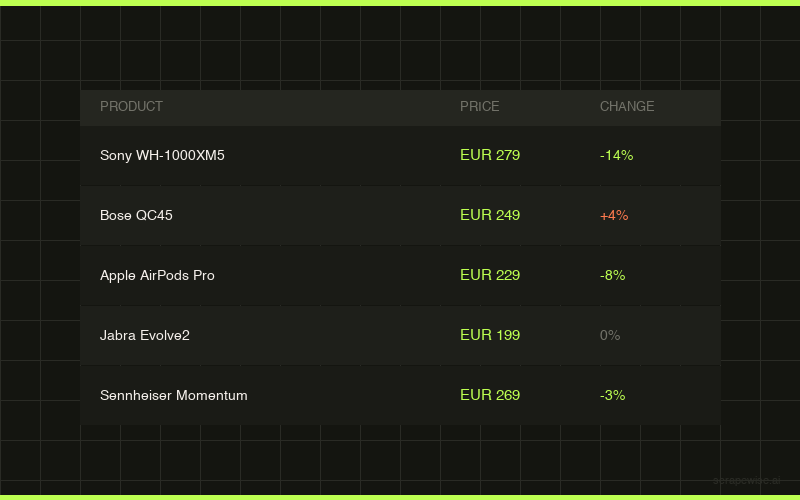
Every ScrapeWise data API page ships a real sample table you can read on the page and download as CSV — no account, no card, no email.
Switching from ParseHub and want it walked through? Book a 15-min call →