

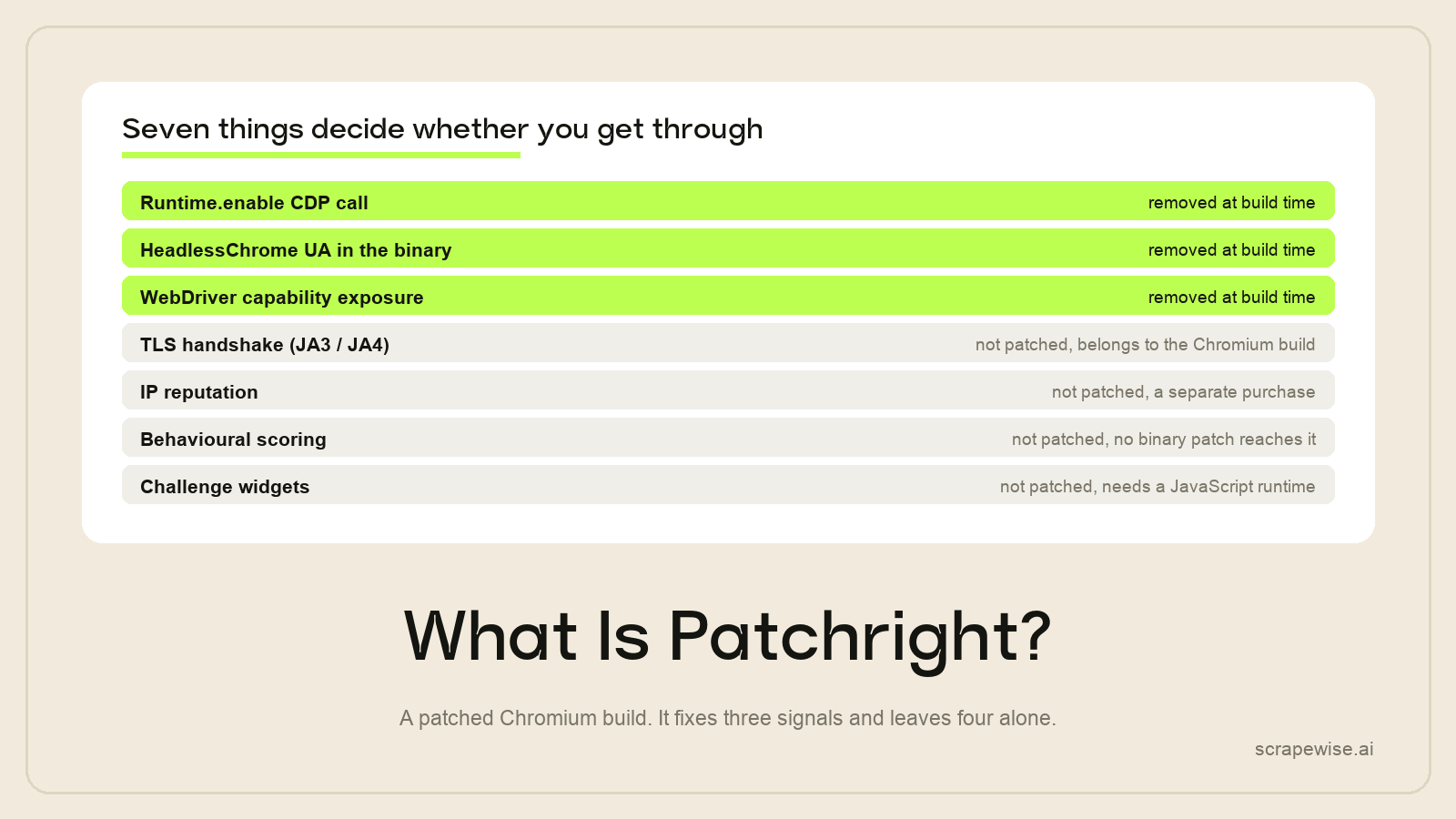
Key takeaways
- Patchright is a patched version of the Playwright driver. You use Playwright's own API; there is no new library to learn.
- Its main patch avoids the Runtime.enable CDP call. It also disables Console.enable and changes Chromium's default launch flags, such as removing --enable-automation.
- Install is pip install patchright or npm i patchright, then a one-line import change. There is a community .NET package; there is no Go port, and Java is still on the project's to-do list.
- Chromium-based browsers only, and the project recommends real Google Chrome over Chromium. A suite running Firefox or WebKit keeps vanilla Playwright for those legs.
- It fixes fingerprint signals, not behavioural ones, and it does not give you proxies.
Patchright is Playwright with its automation leaks patched out. Same API, same selectors, same page.goto(). The difference is in the driver: it stops making the DevTools calls and passing the launch flags that vanilla Playwright uses, and that anti-bot vendors can look for.
If you arrived here from a patchright search wanting to know whether it is a new automation framework you need to learn: it is not. It is a drop-in package. The interesting questions are what it patches, what it leaves alone, and whether that is enough for your target.
Patchright in One Table
Facts below are from the Patchright repository and its Python and Node READMEs, checked Nov 2026.
| Answer | |
|---|---|
| What it is | A patched Playwright driver, published as its own package |
| Language support | Python and Node.js, plus a community-driven .NET package. No Go port; Java is on the to-do list |
| Browser support | Chromium-based browsers only. The project recommends Google Chrome over Chromium |
| API | Playwright's API, drop-in. The README says it passes most, but not all, of Playwright's own tests |
| Maintained by | A small independent team (Kaliiiiiiiiii-Vinyzu) |
| Licence | Apache-2.0, free |
| Fixes fingerprint signals | Some of them |
| Fixes behavioural signals | No |
| Provides proxies | No |
Installing Patchright
Python:
pip install patchright
patchright install chromium
Node.js:
npm i patchright
npx patchright install chromium
Then change the import. Python:
from patchright.sync_api import sync_playwright

with sync_playwright() as p:
    browser = p.chromium.launch(headless=True)
    page = browser.new_page()
    page.goto("https://example.com")
    print(page.title())
    browser.close()
Node.js:
const { chromium } = require('patchright')

const browser = await chromium.launch({ headless: true })
const page = await browser.newPage()
await page.goto('https://example.com')
console.log(await page.title())
await browser.close()
That is the whole migration. Your selectors, page objects, waits and context handling carry over unchanged, because they are Playwright's. Extraction is ordinary Playwright too:
from patchright.sync_api import sync_playwright

with sync_playwright() as p:
    browser = p.chromium.launch(headless=True)
    page = browser.new_page()
    page.goto("https://example-retailer.de/category/laptops",
              wait_until="domcontentloaded")
    page.wait_for_selector("[data-product-card]")

    for card in page.query_selector_all("[data-product-card]"):
        print({
            "name":  card.query_selector("h3").inner_text().strip(),
            "price": card.query_selector("[data-price]").inner_text().strip(),
            "url":   card.query_selector("a").get_attribute("href"),
        })
    browser.close()
One habit worth keeping: wait_for_selector on a real content element, not a fixed sleep. A browser that waits exactly 3,000ms on every page hands back a behavioural signal it did not need to.
The snippets above are the minimal migration. The setup the README itself gives "to be completely undetected" is different: a persistent context, real Chrome (patchright install chrome), headed mode, no fixed viewport, and no custom headers or user agent:
context = p.chromium.launch_persistent_context(
    user_data_dir="...",
    channel="chrome",
    headless=False,
    no_viewport=True,
    # do NOT add custom browser headers or user_agent
)
Headed Chrome on a server means a virtual display, which is a real cost in CI. Two more install-time details. patchright install is its own step, so a CI image that already pins a Playwright browser needs it added. And if both packages are installed in the same environment, an import left pointing at playwright silently gives you the unpatched driver: the run succeeds, the block rate does not change, and nothing in the logs tells you why.
What Gets Patched
Vanilla Playwright is not trying to hide. It is a testing tool, and it announces itself in ways that cost nothing in CI and a lot in production scraping. Per the Patchright README (checked Nov 2026):
1. The Runtime.enable CDP leak. Playwright calls Runtime.enable over the Chrome DevTools Protocol to track execution contexts, and that call can be detected from inside the page. Patchright avoids it by running its JavaScript in isolated execution contexts. The README calls this "the biggest patch", and it is the main reason Patchright gets further than JavaScript-injection plugins like playwright-extra, which do not touch the CDP layer.
2. Console.enable. Also detectable, so Patchright disables the Console API entirely. The side effect: console output does not work in Patchright, which matters if your scraper reads console messages.
3. Launch flags. Patchright adds --disable-blink-features=AutomationControlled so navigator.webdriver is not set, and removes --enable-automation, --disable-popup-blocking, --disable-component-update, --disable-default-apps and --disable-extensions from Playwright's defaults.
It also fixes some smaller leaks in Playwright's own code, and it can reach elements inside closed shadow roots. One caveat the README is open about: init scripts are injected through Playwright routes, which can cause bugs and may be detectable through timing.
The structural point: these changes sit in the driver and the launch, not in JavaScript that rewrites properties after the page loads. Rewriting navigator.webdriver after load is itself detectable, because a guard can spot a property whose descriptor was changed. Never setting it in the first place leaves nothing to spot.
What it does not change is the browser binary. The TLS handshake and the rest of the network fingerprint belong to whichever Chromium or Chrome you launch, which is one reason the README recommends real Chrome.
The Four Limits That Decide Whether It Helps
This is the section most patchright write-ups skip, and it is the one that decides whether the package solves your problem.
It does not address behavioural scoring. Modern bot-management products score things like mouse paths, scroll behaviour, dwell time before the first click and the timing of requests. A patched browser that loads a page, reads the DOM in 400ms and leaves has a pattern no driver patch touches. Against vendors that weight behaviour heavily, such as Akamai Bot Manager and HUMAN (PerimeterX), that is the layer left to catch you.
It does not give you proxies. A clean fingerprint from a datacentre IP that is already flagged is refused at the edge before anything in the browser is evaluated. If a Patchright setup starts working after you add residential proxies, a good part of the improvement is coming from the IP layer, not from the patch.
It does not cover Firefox or WebKit. Patchright only patches Chromium-based browsers. Cross-browser suites keep vanilla Playwright for the other two engines, which means two packages and two code paths.
It does not exist for Go or Java. Playwright ships in Python, Node, Java and .NET. Patchright has Python, Node and a community .NET package; Go has none, and Java is still an open item on the project's to-do list. On a Go stack the realistic options are driving Chrome over raw CDP yourself, or moving the fetch layer out of the browser entirely: see TLS fingerprint impersonation with curl_cffi.
Does Patchright Bypass Cloudflare?
Sometimes, and it depends on the target's configuration. The project's README lists Cloudflare among the systems it says Patchright passes "with the right setup". That is the maintainers' claim, and "the right setup" means the headed, persistent, real-Chrome configuration above, not a headless one-liner.
The reason it does better than playwright-extra is the Runtime.enable patch, because that is a signal stealth plugins working in JavaScript cannot remove. The reason it is not a guaranteed pass on stricter configurations is that those also look at IP reputation and behaviour, and no driver patch reaches either.
Worth being concrete about the common failure sequence, because it is nearly always the same:
- Vanilla Playwright is blocked immediately.
- Patchright passes. The problem looks solved.
- Volume goes up. Rate-limiting starts.
- Residential proxies are added. Things work again for a while.
- Behavioural scoring catches the request timing.
- You are now writing a mouse-movement simulator.
Step 6 is where most teams discover that stealth was never a library choice.
How Patchright Compares to Camoufox, noDriver and playwright-extra
Facts in this table are from each project's repository or package registry, checked Nov 2026. ScrapeWise publishes this blog.
| Tool | Best for | Strengths | Limitations |
|---|---|---|---|
| Playwright | Tests, unprotected targets | Reference implementation, all three engines, Microsoft-maintained | Announces itself through CDP calls and launch flags |
| Patchright | A Python or Node scraper that is being blocked on browser signals | One-line migration, Apache-2.0, free | Chromium only, no behavioural handling, no proxies, small maintainer team |
| Camoufox | High-value, low-frequency protected targets | Firefox fork with fingerprint changes at the C++ level, MPL-2.0 | About 200MB per browser by its own README, which also warns performance has dropped with the current Firefox base |
| nodriver | Lightweight Python crawls on real Chrome | Drives Chrome over CDP with no Playwright or WebDriver layer | AGPL-3.0 licence; no behavioural handling |
| playwright-extra | Nothing new | Historical interest | Last npm release 4.3.6 in March 2023. JavaScript-level patches only. Do not start new work on it |
| ScrapeWise | Teams that want the rows, not the stack | Managed browsers and proxies; pay per page | Not a library you control: you cannot script arbitrary in-page behaviour, some sites still block or need a login, and it is a paid service |
A wider comparison of the open-source options is in Playwright stealth in 2026. For the head-to-head on the specific signals, see Patchright vs Playwright, and for the Firefox comparison, Camoufox vs Patchright.
Patchright by Anti-Bot System
Which layer each system leans on decides whether a driver patch is the right fix. This is reasoning about where Patchright acts, not a pass-rate table.
| System | What Patchright addresses there | Look at instead, or as well |
|---|---|---|
| No WAF | Nothing you need. Patchright buys you nothing over Playwright | Playwright |
| Cloudflare | The browser-automation signals its JavaScript checks can see | IP reputation; Camoufox for the hardest configurations |
| Akamai Bot Manager | Little of what Akamai reads first, because the TLS handshake comes from the browser build | curl_cffi: fix the handshake and skip the browser |
| DataDome | Browser signals, which matter because its JavaScript checks need a real browser | Browser is mandatory here |
| PerimeterX / HUMAN | Browser signals only; behaviour is the bigger part | Every approach hits a ceiling |
The Akamai row is the counter-intuitive one: Akamai reads the TLS handshake before anything in the page, so a correct HTTP client fixes the first signal it checks, and runs without a browser. The full argument, including when to keep the browser anyway, is in Playwright vs Akamai Bot Manager.
Where the Patching Cycle Stops Paying Off
Stealth tools decay. Each anti-bot vendor ships detection updates, each update needs a corresponding patch, and the gap between the two is downtime on whichever data source you depend on. The steady stream of Patchright releases that track Playwright versions is a sign of how much upkeep this takes.
That maintenance cycle does not appear in any install command, and it is the real cost of a self-hosted stealth stack.
If what you need is competitor prices, stock levels and product data arriving in your systems rather than a stealth stack to keep alive, the Patchright question is the wrong one to be answering. ScrapeWise runs the browsers and the proxies and delivers structured rows as a table, CSV or Excel, through the API or over MCP. Pricing is per page, per 1,000 pages: EUR 0.15 for plain requests, EUR 0.75 with rendering, EUR 1.50 through the residential tier and EUR 3.75 for render plus residential. Schedules run at most once a day, plus manual runs. Some sites block automated visits or need a login, and no tool gets every page on every site.
You can also call ready-made scraping API endpoints directly, or see how this feeds competitor price tracking.
So Should You Use Patchright?
- Yes: you have a Python or Node scraper that is being blocked on browser signals. It is the cheapest upgrade available and costs you one import line.
- No: you are writing tests, or your target has no WAF. Use Playwright.
- No: you are on Go or Java. There is no port; fix the TLS layer instead.
- Not enough: you are on Akamai. Drop the browser and get the handshake right.
- Not the question: you want delivered rows on a schedule and would rather not run a stealth stack at all.
That last line has an install command too, and unlike the ones above it there is no browser to keep patched:
pip install scrapewise
from scrapewise import ScrapewiseClient

with ScrapewiseClient() as sw:          # reads SCRAPEWISE_API_KEY from the environment
    html = sw.load_site("https://www.example.com/product/123")
One runtime dependency, and the Chromium and the proxies run on our side.
Create a key and run your own target URLs through it: the first 5 requests are free, no card needed, then the
per-page rates. Twelve read-only LangChain tools over the same API are a second package,
langchain-scrapewise, and the same key works as an MCP server.
Skip the stealth setup
No fingerprints to patch and no proxies to rotate. Paste a URL and get structured data back. 5 free requests, no card.
Not ready to sign up? See 12 real Amazon rows, 972 columns →
5 free requests no credit card · from €0.15 per 1,000 pages · or call it from Python or MCP →