
Hexomatic Alternatives: 6 Tools Compared
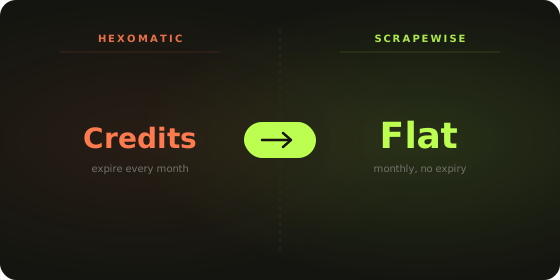
Short version: Hexomatic is an automation platform with scraping as one capability among more than a hundred. That is a real strength when the job is 'scrape this, enrich it, push it to a sheet, notify a channel'. It is a mismatch when the job is simply 'give me this catalogue every morning'. Credits are consumed per step, so your bill tracks workflow complexity rather than data volume — and a premium step inside a loop is how a month's credits disappear in a week. Below: what each realistic Hexomatic alternative bills you for, how much you are still building, and when Hexomatic is the right answer.
Six Hexomatic Alternatives, Side by Side
| Tool | Pricing model | What you still build | Best for |
|---|---|---|---|
| ScrapeWise | €0.15 per 1,000 pages delivered | Nothing — you pick fields, rows arrive | Teams who want the data on a schedule |
| Hexomatic | Credits per automation step | The workflow, and every step inside it | Chaining scraping into a wider automation |
| Octoparse | Seat plus cloud credit packs | The task, and re-records after redesigns | Non-developers with stable, templated targets |
| Browse AI | Credits per robot run | The robot, and re-records after redesigns | Recording a simple click path fast |
| Thunderbit | Credits per row scraped | You run it by hand in the browser | Ad-hoc grabs, not scheduled feeds |
| Kadoa | Per-record credit tier | The verification — which row was wrong | AI extraction on changing layouts |
| Apify | Compute units plus actor rental | The actor, when the marketplace lacks your target | Developers who want a component marketplace |
Which One Is Actually Right for You
Stay on Hexomatic if
Scraping is genuinely one step in a longer chain and the other steps earn their keep — enrichment, AI classification, pushing results into a dozen downstream tools. Nothing else in this list replaces the automation layer. If you also caught an AppSumo lifetime deal, the economics are hard to argue with at low volume.
Choose Octoparse or Browse AI if
You want the extraction without the automation platform around it, and you are comfortable owning the workflow. Octoparse has a stronger builder and a template library; Browse AI is faster to record. Both bill in credits too — you are simplifying the product, not the billing model.
Choose Thunderbit if
The work is genuinely ad-hoc: grab a list off a page now, paste it somewhere, move on. A browser extension is the right size of tool for that. It is the wrong size for anything that needs to run at three in the morning without you.
Choose Kadoa if
Your targets change layout constantly and you want AI to absorb that churn. Self-healing extraction is real. What it does not give you is a verdict on which specific row came back wrong, so budget for verification either way.
Choose ScrapeWise if
The output is the point. You pick the fields once, set a schedule, and rows arrive by REST API or CSV at €0.15 per 1,000 delivered pages — €0.75 rendered, €1.50 residential. No credits per step, no premium actions inside loops, and 36 ready-made endpoints cover common sources with no building at all. Your balance never expires.
Do not choose ScrapeWise if
You need the automation layer itself — multi-step sequences, form fills, actions taken on a site, fan-out into many third-party tools. ScrapeWise reads pages and delivers structured rows. It does not orchestrate. If the orchestration is why you bought Hexomatic, keep it.
Hexomatic vs ScrapeWise
Why Teams Look Beyond Hexomatic
The Bill Tracks Complexity, Not Volume
Every automation step in Hexomatic consumes credits — scraping, enrichment, AI actions, integrations all draw from the same pool, and premium steps draw more. The failure mode is specific: put a premium step inside a loop over 5,000 products and the month's credits are gone in days, from a workflow that looked cheap when you designed it over ten rows. Per-page billing removes the multiplier entirely. A page costs €0.00015 whether one field or forty comes off it, and whatever you do with the row afterwards is free.
Built for Workflows, Not Scraping Scale
Hexomatic excels at connecting many tools. But if your need is large-scale structured extraction rather than workflow orchestration, the platform's breadth works against you: more surface to configure, more places a run can stall, and a mental model built for a different job. Teams monitoring a competitor catalogue daily do not want a canvas of steps — they want a table that is correct this morning.
Automations Are Not a Pricing Feed
A workflow builder gives you steps. You still design the output — which fields, how variants fold, what happens when a price is missing, how yesterday compares to today. That design work is the actual job in price monitoring, and no number of connectors does it for you. ScrapeWise ships the schema decision as part of the product: you choose the fields, and every run returns the same shape.
No In-Platform Analytics
Hexomatic extracts data and sends it elsewhere — Google Sheets, a webhook, an integration. Any filtering, pivoting or comparison happens in whatever tool received it. ScrapeWise keeps every dataset in a built-in data grid, so you can filter, sort, group and pivot in the same window the scrape ran in, then export to CSV, JSON or your warehouse when you actually need to move it.
Automation Breadth, Monitoring Depth
The platform spans a wide range of tasks. Price monitoring rewards depth in exactly one: matching competitor listings to your catalogue, keeping history and detecting what changed. Breadth and depth are different products, and you are buying one of them.
Scheduling Is Not the Same as Coverage
Running a workflow nightly is the easy half. Keeping several thousand competitor URLs resolving night after night, as sites redesign and products get delisted, is the actual job. A schedule that runs successfully on a shrinking set of URLs still looks green.
Scraping Infrastructure Without the Automation Overhead
Hexomatic has genuine depth in automation and no-code workflow building. If you need to chain scraping with dozens of other data tools, it is a reasonable platform and nothing in this comparison replaces that layer. The mismatch appears when a pricing manager or e-commerce team inherits it for what is really a data problem: a catalogue that needs checking every morning, in the same shape every time, without anyone tending a canvas of steps. That is a narrower job, and a purpose-built tool does it for less.
- ✕ Automation credits consumed by every step
- ✕ Premium steps multiply inside loops
- ✕ Complexity built for workflow builders, not data teams
- ✕ No in-platform analytics layer
- ✕ Credits can be depleted before the month ends
- ✓ Pay-as-you-go — no credit consumption per step
- ✓ One published rate per page type
- ✓ Purpose-built for structured extraction at scale
- ✓ Built-in data grid: filter, sort, group, pivot
- ✓ Pay only for pages delivered, balance never expires
What 1.5 Million Pages a Month Costs
| 1.5M pages / month | Hexomatic | ScrapeWise |
|---|---|---|
| What you are billed for | Credits, consumed per automation step | Pages actually delivered |
| Published floor | Free tier is limited credits; Bronze from ~$24/mo | No plan. €0.15 per 1,000 plain pages |
| 1.5M plain pages | Credits × steps per page, then enough plan to cover it | €225 |
| Adding an enrichment step | Multiplies across every page in the run | Free — the row is yours once delivered |
| Pages needing JavaScript | Higher credit consumption | €0.75 per 1,000 — published |
| A run that fails halfway | Credits already spent are spent | Undelivered pages cost nothing |
| Running out mid-month | Workflow stops until you top up the plan | Top up from €5 and it keeps going |
| Unused capacity at month end | Credit rollover is limited | Balance carries — it never expires |
Pricing Comparison
Hexomatic
- - Free: limited automation credits
- - Bronze: from ~$24/mo (credit-based)
- - Silver / Gold: higher tiers with more credits
- - AppSumo lifetime deals available historically
- - Every automation step consumes credits
- - Premium steps consume more, and multiply inside loops
- - Cost scales with workflow complexity, not data volume
Scrapewise
- ✓ Pay-as-you-go: no monthly plan, no quota
- ✓ Plain pages: €0.15 per 1,000 (€0.00015 per page)
- ✓ Render: €0.75 per 1,000 · Super (residential proxy): €1.50 per 1,000
- ✓ You only pay for pages that are delivered
- ✓ No per-step credits — you pay per page, not per action
- ✓ 36 ready-made endpoints and API access included
- ✓ 5 free requests, top-ups from €5, balance never expires
Moving Off Hexomatic
Split the workflow into extraction and everything else
Go through each automation and mark which steps read a page and which act on the result. Only the first group is moving. If the second group is where the value is, keep Hexomatic and feed it from the API instead of replacing it.
Write down the fields and the URLs
For every scraping step, list the target URLs and the fields it returns. That list is the asset. The step configuration around it encodes a site layout from whenever you built it and is not worth carrying over.
Count the real page volume
URLs × run frequency = pages per month. That number is what you will pay on. Most teams find it lower than their credit consumption suggested, because credits were counting steps rather than pages.
Check the 36 ready-made endpoints first
Before rebuilding anything, see whether your source is already covered. If it is, there is no builder step — you call the endpoint and rows come back in a fixed shape, rendered pages included.
Rebuild the most credit-hungry scrape
Pick the workflow that drains the pool fastest, point the visual builder at one of its pages and select the fields from step two. Run it against the 5 free requests, then diff a week of output against Hexomatic's before cutting over.
Point the surviving automations at the API
If you kept the orchestration layer, have it read from the ScrapeWise REST API or the scheduled CSV rather than running its own scrape steps. The credit burn drops to whatever the non-scraping steps cost, which is usually a much smaller number.
Purpose-Built Scraping. No Credit Juggling.
Stop managing credit pools across automation steps. ScrapeWise is built specifically for web scraping — extract, analyze, and export structured data with pay-as-you-go pricing and no workflow complexity.
Frequently Asked Questions
Common questions when comparing Hexomatic and ScrapeWise.
It depends on which half of Hexomatic you are replacing. If you need the automation layer, nothing in this list is a straight swap — keep it and change only the scraping. If you want extraction without the platform around it, Octoparse or Browse AI. For ad-hoc grabs, Thunderbit. For AI extraction on volatile layouts, Kadoa. If you want a reliable structured feed with no credits per step, ScrapeWise at €0.15 per 1,000 delivered pages.
Don't take the table's word for it
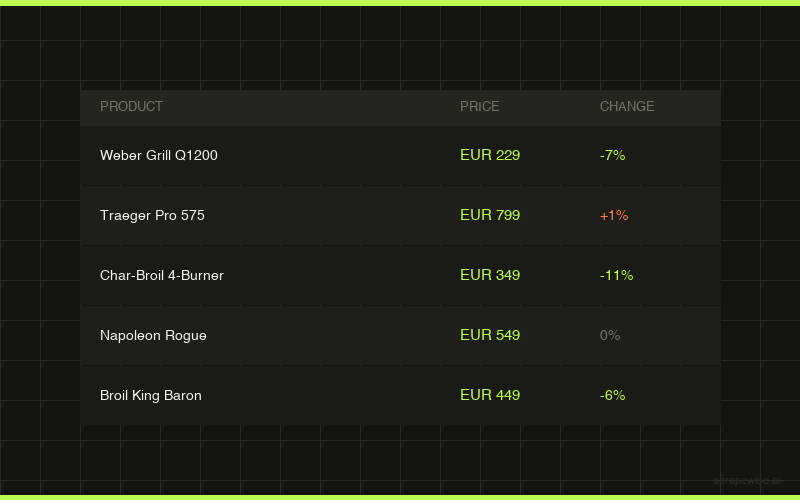
Every ScrapeWise data API page ships a real sample table you can read on the page and download as CSV — no account, no card, no email.
Switching from Hexomatic and want it walked through? Book a 15-min call →