
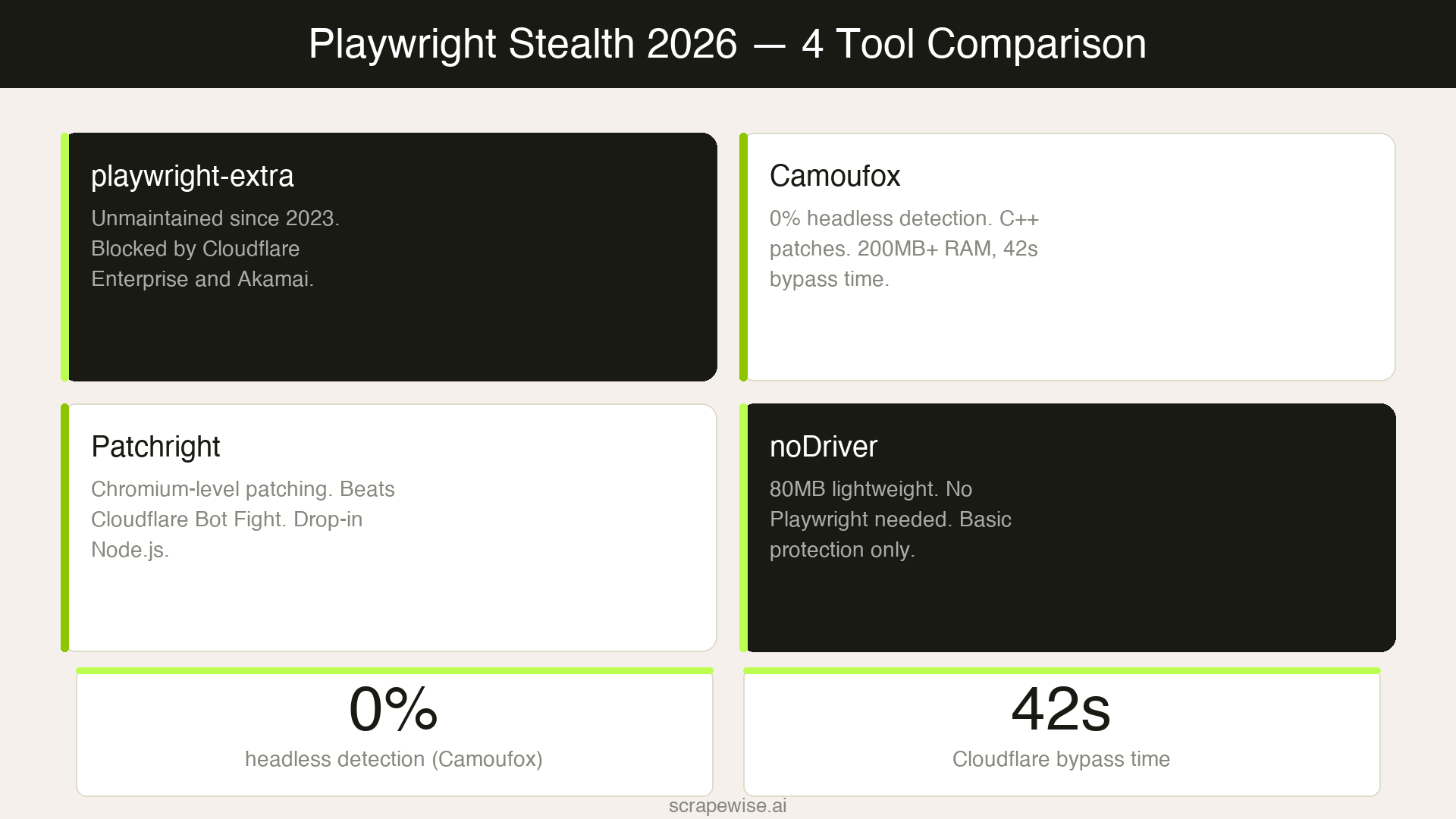
Most teams running playwright-extra with the stealth plugin haven't checked its release history recently. The last npm release of both playwright-extra and puppeteer-extra-plugin-stealth landed on 1 March 2023 (npm registry, checked Nov 2026). Three years of Cloudflare updates, Akamai Bot Manager v4, and DataDome's behavioral analysis later — and the plugin most Node.js scrapers rely on is quietly losing the detection war.
If your scraper is getting blocked and you're unsure whether to patch harder or switch tools entirely, this guide gives you a decision framework, the layer each tool actually patches, and a plain comparison of the four main playwright stealth 2026 approaches: playwright-extra, Camoufox, Patchright, and noDriver.
Skip the stealth setup: one API call. If you need the data rather than the scraper, send the page URL to the Scrapewise API and get structured rows back. Each page is fetched plain first and moved to a real browser or residential IPs only when it is blocked, so there is no patching Playwright on your side. Some sites still block automated visits or need a login, so no tool covers every target. For competitor prices, the rows can also be cleaned and matched to your products, ready for competitor price tracking. Try it with 5 free requests.
Choose Before You Read: The Decision Framework
Skip the deep dives if you need an answer fast:
| Your situation | Recommended tool |
|---|---|
| Python stack, simpler sites (no heavy WAF) | playwright-stealth v2.x (Python) |
| Node.js stack, you need maintained stealth | Patchright |
| High-security targets (Cloudflare Enterprise, PerimeterX) | Camoufox |
| Lightweight crawls, no Chromium overhead | noDriver |
| Production scale, 10K+ pages/day, team < 5 engineers | Managed scraper infrastructure |
The rest of this post explains the reasoning behind each row.
The Stealth Patching Landscape in 2026
When Playwright runs in headless mode, it leaks signals. The original playwright-extra stealth plugin addresses this by injecting JavaScript patches before page load: removing navigator.webdriver, spoofing navigator.plugins, faking WebGL renderer strings, and a dozen similar tweaks.
The problem: these are JS-layer patches. Anti-bot systems have moved up the stack. Cloudflare's current detection fires on TLS fingerprint mismatches and HTTP/2 SETTINGS frames — signals that exist before JavaScript runs. No amount of navigator.webdriver = undefined fixes a Chrome/115+ TLS fingerprint coming from a headless binary.
This is why the tool landscape split in two clear directions:
- JS-patch tools (playwright-extra, playwright-stealth): effective against simpler detection, cheap to run
- Browser-patch tools (Patchright, Camoufox): modify the browser binary or its build to remove headless signals at the C++ level — far harder to detect, far more resource-intensive
Understanding this split is the entire framework for choosing a stealth tool. Everything else is implementation detail. If you're still choosing between Playwright and Puppeteer as base frameworks, our Playwright vs Puppeteer comparison for e-commerce scraping covers those tradeoffs first.
playwright-extra (Node.js): Effectively Unmaintained
playwright-extra is a plugin-based wrapper around Playwright for Node.js. The puppeteer-extra-plugin-stealth port provides around 20 JavaScript evasion patches.
Status in 2026: The package has had no npm release since v4.3.6 on 1 March 2023. The stealth plugin's patches were written for Chrome 109–112 era detection patterns. Sites running Cloudflare Bot Fight Mode or DataDome's 2024+ behavioral analysis consistently detect it.
What it still handles: Basic bot detection on sites using dated scripts — user-agent checks, navigator.webdriver flags, rudimentary plugin and renderer checks. It works for scraping sites with no active WAF or sites that haven't updated their detection stack.
What it fails against: Cloudflare Turnstile, Cloudflare Bot Fight Mode (2024+), DataDome behavioral analysis, Akamai Bot Manager v4, PerimeterX/HUMAN.
Maintenance status: Community-only. The GitHub repo is not archived, but it carries 239 open issues (checked Nov 2026) and nothing has shipped to npm in over three and a half years.
When to use it: Legacy Node.js codebases scraping low-security targets where blocking isn't happening. Don't build new infrastructure around it.
- Detection rate on Cloudflare Enterprise: High (blocked)
- Memory per instance: ~180MB
- Maintenance status: Unmaintained
playwright-stealth (Python): Still Active
The Python equivalent — playwright-stealth — is a separate codebase maintained by a different team. Version 2.0.3 shipped on 4 April 2026 (PyPI, checked Nov 2026), after 2.0.1 in January and 2.0.2 in February, meaning it's actively maintained and tracks current detection patterns more closely than its Node.js counterpart.
If your stack is Python, playwright-stealth v2.x is a valid starting point. It applies equivalent JS patches — navigator.webdriver removal, screen resolution spoofing, language and plugin array normalization — with the maintainer actively updating patch coverage as new detection vectors emerge.
Its ceiling is the same as the Node.js version: JS-layer patches don't stop TLS fingerprinting. But for Python teams hitting mid-tier targets, it remains the simplest path.
- Detection rate on Cloudflare Enterprise: High (blocked)
- Memory per instance: ~180MB
- Maintenance status: Active (v2.0.3, April 2026)
Patchright: Chromium-Level Patching for Node.js
Patchright is a drop-in replacement for Playwright that patches the Playwright driver rather than injecting JavaScript into the page. Its README calls avoiding the Runtime.enable CDP call its biggest patch; it also adds --disable-blink-features=AutomationControlled, drops --enable-automation and similar launch flags, and disables Console.enable. It works with Chromium-based browsers only and recommends running real Chrome.
Key technical difference from playwright-extra: Patchright's patches happen before the browser process starts, not in the page context. This means:
- No JavaScript injection overhead at page load
- Patches survive
Object.definePropertyguards that can detect JS-injection tricks - TLS fingerprint is closer to a real Chrome session
Detection rate: Patchright consistently passes the standard nowsecure headless detection test used by most Cloudflare implementations. Against Akamai Bot Manager and PerimeterX, results vary by target — behavioral analysis (mouse movement patterns, event timing) still catches it on the highest-security configurations.
Resource profile: ~200MB per instance, similar to standard Chromium. No additional overhead vs normal Playwright.
When to use Patchright: Node.js codebases targeting Cloudflare-protected sites where playwright-extra fails. It's the most practical upgrade path for teams already on Playwright + Node.js who don't want to adopt Firefox or change language ecosystems. For the migration itself and the signals it does not patch, see Patchright vs Playwright; for install commands, language and browser coverage, and the limits in one place, see What Is Patchright?
- Detection rate on Cloudflare BotFight/Enterprise: Low (passes most targets)
- Detection rate on Akamai/PerimeterX: Variable
- Memory per instance: ~200MB
- Maintenance status: Active
Camoufox: Maximum Stealth, Maximum Cost
Camoufox takes the most aggressive approach: it forks Firefox's source code and applies stealth patches at the C++ level. Every detection signal that anti-bot systems look for — canvas fingerprinting, WebGL renderer, AudioContext behavior, font metrics, network timing — is controlled at the binary level, not the JavaScript layer.
What the project claims: Camoufox's site says it "modifies fingerprint data at the C++ implementation level, not via JavaScript injection", and calls the browser "undetectable by design" (camoufox.com, checked Nov 2026). That second line is marketing, not a published measurement, so treat it as a goal rather than a result. What the design does buy you is that there are no injected scripts for a detector to find.
The cost: Running a full Firefox per worker comes with real resource overhead:
- Challenge time: a new session that meets a Cloudflare challenge has to load and pass it before any data comes back, which adds seconds per session
- Memory per instance: around 200MB per browser, by the project's own figure
- Firefox-only: Target sites that behave differently in Firefox vs Chrome (JS engine quirks, rendering differences) may require additional handling
- Maintenance risk: Camoufox is a Firefox fork maintained by a small team. Keeping pace with Firefox security releases creates a potential lag on newly-discovered detection vectors
When to use Camoufox: High-security targets where detection is genuinely costly — price intelligence on Cloudflare Enterprise-protected retailers, brand monitoring on PerimeterX-guarded marketplace platforms, or any target where a single block means losing a critical data source. European retailers like Zalando, About You, and ASOS UK run enterprise-grade bot protection across their catalog endpoints; Camoufox is the appropriate tool for these targets.
When not to use Camoufox: High-volume crawls. With a full browser at around 200MB per instance and a challenge to clear on each new session, collecting product data at scale across tens of thousands of SKUs daily requires significant infrastructure investment. The economics rarely support using Camoufox for commodity data collection — we run that arithmetic out in Camoufox vs Patchright, and in Camoufox vs Playwright we show why the two are not alternatives at all: Camoufox is a browser Playwright drives, and the real choice is which binary you point it at.
- Detection rate on Cloudflare Enterprise: Very Low (passes)
- Detection rate on PerimeterX/HUMAN: Low (passes)
- Memory per instance: ~200MB (project's own figure)
- Maintenance status: Active (small team)
noDriver: Lightweight, Limited
noDriver takes the opposite approach from Camoufox: instead of adding more patches, it removes Playwright entirely and drives Chrome directly via the Chrome DevTools Protocol without the automation flags that expose headless status.
By skipping Playwright's WebSocket bridge, noDriver avoids the Runtime.enable CDP call that modern detection systems specifically flag. The result is a significantly lighter process — no Playwright binary overhead, lower memory use — with a baseline level of stealth that passes simple detection.
What it handles well: Basic anti-bot measures, sites that detect the automation flag but don't run behavioral analysis. It's actively maintained and used widely in the Python scraping community.
What it doesn't handle: Behavioral scoring. noDriver does not fake mouse movements, scroll events, or keystroke timing patterns. Against DataDome, Akamai Bot Manager v4, or PerimeterX/HUMAN — all of which score behavioral signals heavily — it gets blocked quickly.
- Detection rate on basic bot detection: Low (passes)
- Detection rate on Akamai/PerimeterX behavioral: High (blocked)
- Memory per instance: ~80–120MB (significantly lighter)
- Maintenance status: Active
That memory figure is the reason to pick it, not the stealth — on a fixed box it buys roughly double the concurrent workers. We work through the trade in full in nodriver vs Playwright, including where it sits against Camoufox.
Anti-Bot Compatibility Matrix
| Anti-bot system | playwright-extra | playwright-stealth (Py) | Patchright | Camoufox | noDriver |
|---|---|---|---|---|---|
| Cloudflare BotFight (free tier) | ✓ Often passes | ✓ Often passes | ✓ Passes | ✓ Passes | ✓ Passes |
| Cloudflare Enterprise / Turnstile | ✗ Blocked | ✗ Blocked | ✓/✗ Variable | ✓ Passes | ✗ Blocked |
| Akamai Bot Manager v4 | ✗ Blocked | ✗ Blocked | ✓/✗ Variable | ✓ Passes | ✗ Blocked |
| PerimeterX / HUMAN | ✗ Blocked | ✗ Blocked | ✓/✗ Variable | ✓ Passes | ✗ Blocked |
| DataDome | ✗ Blocked | ✓/✗ Variable | ✓/✗ Variable | ✓ Passes | ✗ Blocked |
| Basic bot detection (no WAF) | ✓ Passes | ✓ Passes | ✓ Passes | ✓ Passes | ✓ Passes |
✓/✗ Variable = passes technical fingerprint checks but behavioral analysis may still block depending on the target site's implementation depth. The table summarises which detection layers each tool patches; it is not a measured pass rate, and results on any given site change whenever the vendor updates its detection.
The Akamai row deserves a caveat that applies to this whole table. Every column above is a browser, and Akamai ranks TLS fingerprinting as its primary signal, which is the one thing no browser-side patch controls. A plain HTTP client with TLS fingerprint impersonation fixes that layer directly and never runs Akamai's sensor script, so it can get further than a stealth browser there, for a fraction of the compute. So if your target is Akamai, the right question is not which stealth browser to pick but whether to run a browser at all.
Where Stealth Infrastructure Breaks Down at Scale
Even the stealthiest browser becomes a bottleneck at volume. With a challenge to clear on each new session and around 200MB of RAM per instance, running a competitor price tracking pipeline across 50,000 SKUs daily requires either significant infrastructure spend or accepting data gaps from rate-limited and blocked sessions.
This is the point at which maintaining stealth infrastructure stops being a scraping problem and becomes an engineering resource problem. Teams tend to hit this ceiling soon after reaching meaningful production volume. The recurring cost isn't the initial setup — it's the weekly maintenance cycle as anti-bot systems update their detection signatures and each tool requires patches to keep up.
The alternative is treating stealth, proxy rotation, and challenge solving as infrastructure rather than application code. This is what the anti-bot arms race ultimately forces on teams that want reliable data without a dedicated scraping engineering function.
ScrapeWise, which publishes this blog, takes the fetch layer off your hands: each page is tried plain first and moved to a real browser or residential IPs only when it is blocked, so engineering cycles go toward building on top of the data rather than maintaining the collection layer underneath it. It will not get through every site; some block automated visits outright or need a login. If you want to see what comes out the other side before writing any code, the Amazon data API page shows 12 real product rows, readable on the page and downloadable as CSV without an account.
The Playwright Stealth Decision in 2026
The playwright stealth landscape is not "install this plugin and you're done." It's a spectrum from lightweight JS patches (playwright-extra, noDriver) to binary-level browser forks (Camoufox), with meaningfully different cost and detection tradeoffs at each level.
The honest summary:
- playwright-extra (Node.js): Use only if you're locked into legacy infrastructure and your targets haven't upgraded their WAF. Don't build new systems on it.
- playwright-stealth (Python): Solid maintained option for Python teams on mid-tier targets without enterprise-grade anti-bot.
- Patchright: The practical upgrade for Node.js teams hitting Cloudflare, without adopting Firefox or changing language stacks.
- Camoufox: Best-in-class detection avoidance for the hardest targets, expensive at volume — right tool for high-value, low-frequency scraping.
- noDriver: Lightest memory footprint, appropriate only for targets with basic or no active WAF.
Every option above decays: each WAF update needs a matching patch, and the gap between the two is downtime on the data. If none of these five is a stack you want to keep alive, there is a sixth line with nothing in it to maintain:
pip install scrapewise
from scrapewise import ScrapewiseClient

with ScrapewiseClient() as sw:          # reads SCRAPEWISE_API_KEY from the environment
    html = sw.load_site("https://www.example.com/product/123")
The patch cycle in this article becomes ours, though no tool gets through every site. Create a key and run your own URLs: the first 5 requests are free, no card needed, then the pay-as-you-go rates of €0.15 to €3.75 per 1,000 pages depending on page type.
Already have the URLs? Scrape a list of URLs in one run: upload the CSV and get back one clean row per link.
Skip the stealth setup
No fingerprints to patch and no proxies to rotate. Paste a URL and get structured data back. 5 free requests, no card.
Not ready to sign up? See 12 real Amazon rows, 972 columns →
5 free requests no credit card · from €0.15 per 1,000 pages · or call it from Python or MCP →