
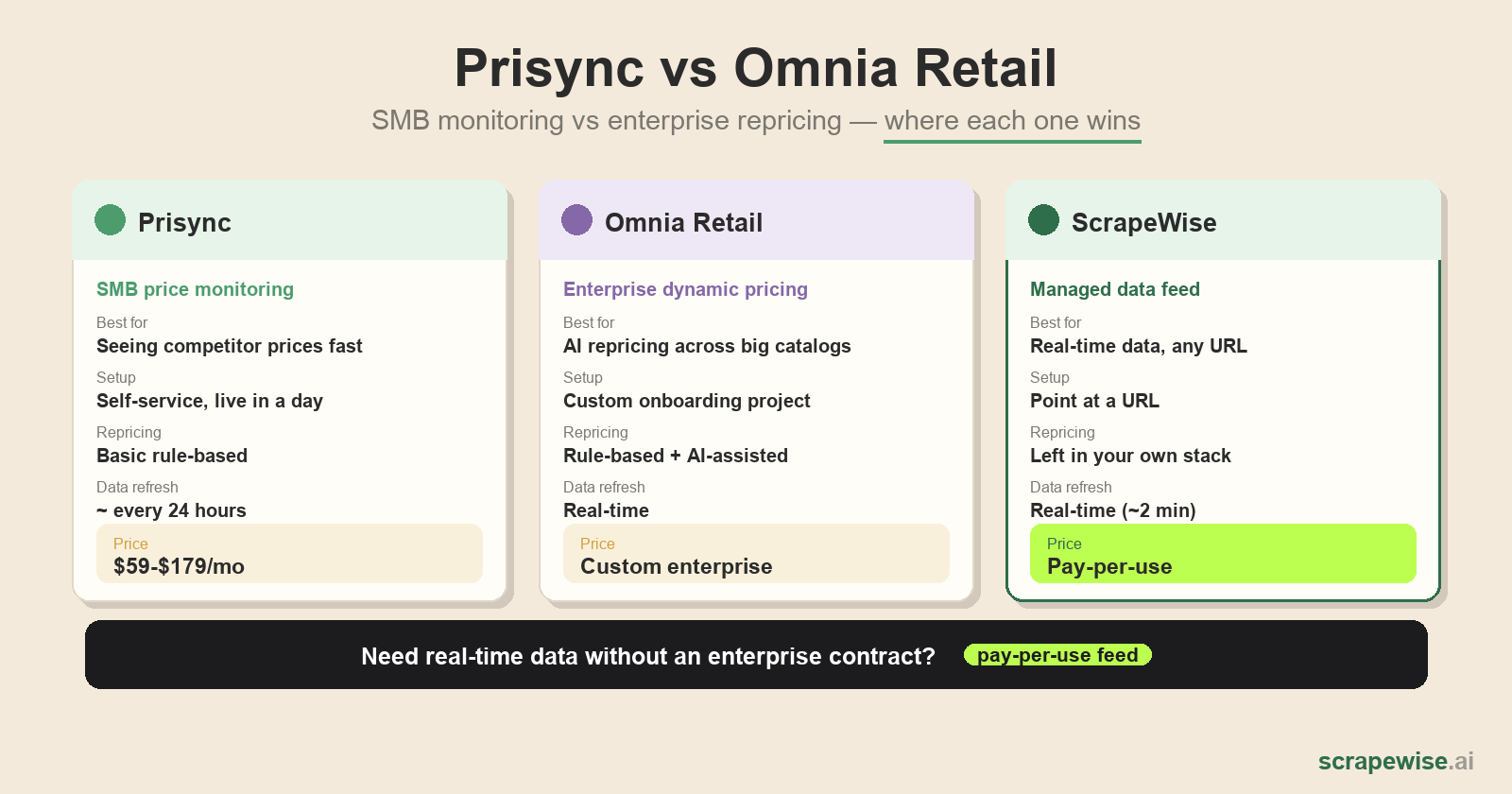
Prisync and Omnia Retail sit at opposite ends of the price-monitoring market. Prisync is a self-service SMB tool — sign up, add products, get competitor prices in a day. Omnia Retail is an enterprise dynamic pricing suite — monitoring, AI-assisted repricing, and comparison-shopping-engine integration, sold as a considered enterprise purchase.
So the honest answer to "which wins" is: it depends on whether you need visibility or a full repricing engine — and how much you're willing to spend to get it.
Which One Fits Your Situation?
Short answer: Prisync is better for small and mid-sized retailers that want affordable, self-service competitor price monitoring from $99 a month, with repricing rules from the $199 Premium plan. Omnia Retail is better for large retailers that need AI-assisted dynamic repricing across many channels and can take on a custom enterprise contract. Both rate highly on Capterra, and Prisync scores higher on ease of use.
| Your situation | Better fit |
|---|---|
| SMB, need competitor prices fast and cheap | Prisync |
| Enterprise, need AI-driven dynamic repricing | Omnia Retail |
| Large multi-channel catalog + comparison engines | Omnia Retail |
| Just want monitoring, not automated repricing | Prisync |
| Need data from any or custom source on your own schedule | Neither: data infrastructure |
Quick Comparison
| Prisync | Omnia Retail | |
|---|---|---|
| Category | SMB monitoring | Enterprise dynamic pricing |
| Setup | Self-service, same day | Onboarding project |
| Repricing | Basic rules | AI-assisted, core feature |
| Update frequency | Up to 3x daily | Real-time |
| Sources | Competitor URLs or channels | Preset channels + CSEs |
| Pricing | $99 to $399/mo | From €399/mo, enterprise quoted |
Prisync vs Omnia Retail: What Reviews Say
On Capterra, Prisync rates a little higher than Omnia Retail overall and on ease of use, features and value for money, and the two tie on customer service. Keep the sample sizes in mind: Prisync has 129 reviews there and Omnia Retail has 24.
| Capterra (September 2026) | Prisync | Omnia Retail |
|---|---|---|
| Overall | 4.8 / 5 (129 reviews) | 4.6 / 5 (24 reviews) |
| Ease of use | 4.7 | 4.5 |
| Customer service | 4.9 | 4.9 |
| Features | 4.5 | 4.3 |
| Value for money | 4.7 | 4.4 |
What Prisync reviewers say: the interface is easy to use and support answers quickly. The most common complaint is setup time, because every product and competitor URL has to be added and kept up to date.
What Omnia Retail reviewers say: pricing strategies are flexible and support is strong. Complaints include cost for smaller retailers, assortment analytics that happen outside the tool, and a 2021 review noting that catalogs above 50,000 products were hard to handle.
Ratings change often. Check Capterra for the latest figures.
Prisync: Fast, Cheap, Self-Service
Prisync's appeal is friction. Plans run from $99 to $399 a month for up to 5,000 products, and you're live in a day. For a smaller retailer that mainly needs to see competitor moves, that's often all that's required.
The limits show up as you scale: repricing is basic rules rather than demand-aware strategy, and updates run one to three times a day rather than in real time, which is fine for stable categories but risky during promotional windows. Our Prisync alternative guide covers where it hits a ceiling.
Omnia Retail: The Enterprise Repricing Engine
Omnia is an end-to-end system: Pricewatch monitors competitors and comparison shopping engines, and its dynamic pricing engine acts on that data with rule-based and AI-assisted strategies. For a retailer repricing thousands of SKUs across Google Shopping, bol.com, and idealo, that integration is valuable, and Omnia's site shows G2 Leader badges for retail pricing software (September 2026).
The weight is cost and scope: plans from €399 per month for a single shop and quoted enterprise pricing, an onboarding period, and a full repricing suite you pay for even if you only wanted monitoring. Sources outside its preset network, such as regional distributors and private B2B portals, can also fall through. Our Omnia Retail alternative comparison breaks down the switch triggers.
The Overlap Neither Covers Well
Both are SaaS platforms with preset site networks. If your competitors sit on custom checkouts, regional portals, or wholesale catalogs outside those networks, neither reaches them cleanly.
That's where a managed price monitoring infrastructure is a different shape: it scrapes any URL you point it at and delivers clean structured data, with no repricing engine and no preset-network limit. In internal testing (Apr 2026), ScrapeWise returned 97% SKU coverage and 96% anti-bot success on Amazon EU, with scheduled or on-demand runs on pay-per-use pricing. Repricing logic stays in your own stack.
How to Choose
- Do you need repricing or just visibility? Visibility → Prisync. Automated dynamic repricing → Omnia.
- What's your budget shape? Fixed low monthly → Prisync. Enterprise contract for a full suite → Omnia.
- How fast must data be? Daily is fine for stable categories; real-time matters in promo-heavy ones.
- Are your sources standard? If competitors sit off the preset networks, a managed feed reaches them.
The Bottom Line
Prisync wins for SMBs that need affordable, fast competitor visibility. Omnia Retail wins for enterprises that need a real dynamic pricing engine and can absorb the contract. If your real need is accurate data from any source, on your own schedule and without a repricing suite, a managed feed beats both.
If Omnia is the one you are trying to replace, see our Omnia Retail alternatives. Still comparing more vendors? See our ranked list of the price monitoring tools we tested.
Paste a URL your current tool cannot reach
See why teams switch to ScrapeWise. 97% accuracy benchmark, no per-SKU pricing.
Not ready to sign up? See 40 rows from a real Amazon search →
97% accuracy on Amazon benchmarks · no credit card · book a 15-min call →