

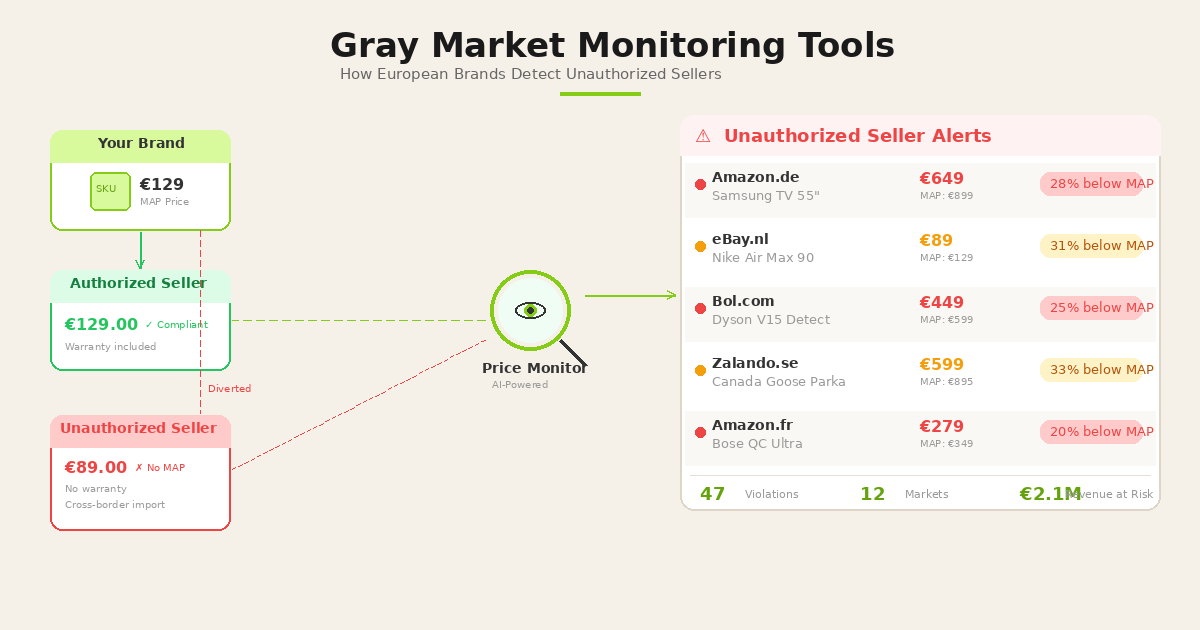
Your product shows up on Amazon.de, Bol.com or a dealer webshop at a price your authorized partners can't match, from a seller nobody on your team recognises. You want to know who it is, where the stock came from and what you can do about it.
The short answer: no single tool does all of that. Brand-protection suites (Red Points, MarqVision, Smart Protection) find listings and file takedowns. Price monitors (Price2Spy, Prisync, Minderest) catch sellers pricing under your MAP or RRP. Data tools like ScrapeWise collect listing and seller rows from the sites the others don't cover, and your team decides what to do. Most brands end up with two of the three.
This guide compares seven options by what their own websites say (checked 9 November 2026), then goes industry by industry: beauty, auto parts and pharma. ScrapeWise publishes this blog, so read our part of the comparison with that in mind.
What is gray market monitoring?
Gray market monitoring is the regular tracking of listings, prices and sellers across marketplaces and webshops to find genuine products sold outside your approved channels. It is not counterfeit detection. The goods are real, but they come from parallel imports, diverted distributor stock or resellers you never authorised, and they usually undercut the partners you rely on.
The difference matters in Europe. Under EU trade mark law, once a genuine product has been put on the market in the European Economic Area with your consent, you generally can't stop it being resold inside the EEA. So a German-market SKU sold cheaper on a Dutch marketplace is often legal. What you can act on is a broken distribution contract, goods imported from outside the EEA, or products that have been changed or relabelled. That is why the evidence you collect matters more than the alert.
The market these sellers work in keeps growing. According to the European E-commerce Report 2025, published by Ecommerce Europe and EuroCommerce, European B2C e-commerce turnover grew 7% to €842 billion in 2024.
What are the best tools for monitoring grey market sales across marketplaces?
The best grey market monitoring tool depends on what hurts you most. If you need takedowns at scale, use a brand-protection suite such as Red Points, MarqVision or Smart Protection. If the damage shows up as below-MAP prices, use a price monitor such as Price2Spy, Prisync or Minderest. For regional sites the others miss, add a data tool.
Here is what each vendor says about itself. We took the wording from each company's own website on 9 November 2026. Coverage numbers are the vendors' own claims, and we have not checked them independently.
| Tool | Type | What the vendor's site says | Published price | Best fit |
|---|---|---|---|---|
| Red Points | Brand-protection suite | "Block unauthorized sellers and parallel imports"; detect and remove infringing listings on "5000+ marketplaces"; test purchases offered as a service | Not shown on the homepage | Takedown volume on big marketplaces |
| MarqVision | Brand-protection suite | "Counterfeits, impersonation, gray market and piracy in one AI platform"; "1,500+ marketplaces, social platforms, and sites monitored" | Not shown on the homepage | Brands with counterfeit and gray market problems at once |
| Smart Protection | Brand-protection suite | "Identify unauthorized sellers and distribution channels"; "flat-fee pricing with unlimited takedowns" | Flat fee, amount not shown | Predictable cost with many takedowns |
| Price2Spy | Price monitor | "Instant alerts when advertised prices fall below MAP"; tracks "seller activity across major marketplaces" | Not listed on the pricing page; 14-day free trial | MAP alerts across retailers |
| Prisync | Price monitor | MAP monitoring is in the Platinum tier only; marketplace price tracking from Premium | Platinum $399, $599 or $799 a month, depending on the model | Smaller catalogues (Platinum covers 5,000 products) |
| Minderest | Price monitor | MAP and MSRP monitoring; a Marketplace Sellers Benchmark to "Spot unauthorized sellers" | Not shown on the homepage | Brands watching retailers and marketplace sellers together |
| ScrapeWise (publishes this blog) | Data platform | Amazon offers and seller APIs plus AI scrapers for other public sites; runs at most once a day; no alerts or takedowns | Pay as you go: Amazon calls €0.15 per 1,000; Managed Data from €1,500/month | Regional marketplaces and dealer webshops, data into your own sheet or BI |
How to read the table. Suites earn their price when filing takedowns is the daily job. Price monitors are cheaper when your gray market problem shows up first as price erosion. Neither covers every regional marketplace or small dealer webshop, which is where a data tool fits. For a wider look at price tools, see our comparison of competitive price monitoring tools.
If the listings you find turn out to be fakes, the path is IP enforcement, not channel management. Our guide to counterfeit detection and brand protection covers that side.
How do you monitor unauthorized sellers across multiple marketplaces?
To monitor unauthorized sellers across marketplaces, search every marketplace you sell on by EAN or SKU, list every seller on each listing, and compare them with your authorized-distributor list. Flag unknown sellers and prices below MAP or RRP. Keep the listing URL, seller ID, price and date for each one, because that is your evidence.
The evidence that holds up with a distributor is not a screenshot. It is the seller behind the offer. On Amazon that takes two lookups: the offers on your ASIN, then each seller's profile page. Under the Digital Services Act, marketplaces "must verify and display the contact details of sellers", so EU seller pages often show the company name and address, and sometimes a VAT number.
| Step | What you collect | Example row (made-up sample) |
|---|---|---|
| 1. Offers on your ASIN | Seller name, seller ID, price, condition, ships from | "NordImport", A1B2C3..., EUR 164.00, new, ships from PL |
| 2. Seller profile page | Business name, address, VAT number (when shown), feedback | NordImport Sp. z o.o., Poznań, PL VAT number, 92% positive |
| 3. Your check | Is the seller on your authorized list? Is the price below RRP or MAP? | Not authorized, 18% below RRP: escalate |
On ScrapeWise, step 1 is the Amazon offers API and step 2 is the Amazon seller API. Step 3 is your call. We collect and document the sellers; filing takedowns stays with you or your brand-protection tool. If you want a contact list of the sellers on your products, see Amazon seller leads.
Outside Amazon, check the comparison sites your buyers use. In Germany, idealo lists many shops side by side for the same product, so it's a quick place to spot a shop you don't recognise undercutting your German price. Prisjakt and PriceRunner do a similar job in the Nordics.
What are the best solutions for monitoring grey market activity in the beauty industry?
For beauty brands, the best grey market monitoring combines a seller check on Amazon, Bol.com and Zalando-type marketplaces with a label check. Parallel-imported cosmetics often carry a non-EU address or no local-language text. A suite like MarqVision or Red Points suits takedowns; a price monitor or data feed suits finding below-RRP sellers.
Beauty is where gray market volume gets big. MIT Sloan Management Review cites a study of health and beauty aid manufacturers where gray market sales were 20% of authorized sales in some markets and as much as 50% in others.
EU cosmetics rules give you something concrete to look for. The Cosmetics Regulation (EC) 1223/2009 only allows products on the EU market when a responsible person is designated in the EU, and the label must show that person's name and address. The language of parts of the label is set by each member state. So a listing photo showing a Korean, Japanese or US address and no German or Swedish text points to a parallel import from outside the EEA. That is the case where you have the most room to act.
What to collect for each beauty listing:
- seller name and ID, and whether they're on your authorized list
- price against your RRP in that country
- listing photos, so someone can check the label address and language
- the EAN, because shade and size variants are easy to mix up
Tying each listing to the right shade and size is where manual checks slow down most, which is why matching sits in step 3 of the process below. More on the beauty side in our industry guide for pharma, beauty and auto parts and on the beauty industry page.
What are the best tools for monitoring gray market auto parts sales?
For auto parts, the best gray market monitoring searches by OE part number as well as EAN, because many sellers list parts by number rather than brand. It should cover eBay, Amazon and the dealer webshops where parts sell. Suites handle takedowns on big marketplaces; scheduled scraping of named webshops covers the long tail they miss.
Auto parts have a different shape from beauty. A lot of the trade runs through independent dealer webshops and specialist parts sites, not only the big marketplaces. Each part may have an OE number, an aftermarket cross-reference and a brand, and gray market sellers often list several of these in one title.
What to collect for each auto parts listing:
- the OE part number and brand as written in the title
- seller name, location and whether they're an authorized dealer
- price against your list price in that country
- ship-from country, which shows cross-border flows inside the EU
Enterprise suites quote coverage in thousands of marketplaces, but ask them for the specific parts sites and dealer shops you care about by name. If they're missing, a configurable scraper can collect those pages on a schedule. See the auto parts industry page.
How do you monitor unauthorized pharmaceutical sellers online?
To monitor unauthorized pharmaceutical sellers in the EU, check whether each website selling your medicine shows the common EU logo and whether that logo links to the seller's entry in the national register. Sellers without it, or with a logo that links nowhere, are your first list. Marketplaces and social channels need separate checks.
The European Commission says that since 1 July 2015 all online pharmacies and retailers legally operating in the EU should display the common logo. Clicking it should take you to that pharmacy's entry on the national list. That gives pharma brands a check that doesn't depend on price: is this seller registered at all?
Price still matters. A prescription product sold far below the normal price, or a listing on a general marketplace, is worth a closer look. Many pharma problems also start on Instagram, TikTok or messaging apps rather than on marketplaces. For those channels, see how brands monitor unauthorized sellers on Instagram, TikTok and WhatsApp and the pharma industry page.
How do you detect product diversion and find the source?
To detect product diversion, look for patterns, not single listings. Several unknown sellers offering the same SKU at similar low prices, shipping from the same country, usually points to one leaking distributor or a liquidation channel. Then confirm with test buys and serial or batch numbers, which tie the goods back to a specific shipment.
A single unauthorized listing is a nuisance. A cluster of sellers getting stock below your wholesale price is a supply chain leak. Look at three things over a few weeks:
- Who. The same seller names or addresses across Amazon, eBay and regional sites.
- Where from. Ship-from countries. Stock from a lower-price EU market showing up in Germany or Sweden is the classic cross-border flow.
- When. New sellers appearing right after a big distributor order or a promotion.
Law firm Mayer Brown, writing in October 2025, recommends AI-driven monitoring tools, sample test buys, and serial number tracking and authentication programs to find and deal with unauthorized sales. A test buy gives you the packaging, the batch code and often the sender's address, which the listing alone never shows.
How do you build a gray market monitoring process?
Start with a clean list of your authorized sellers and their territories. Then collect listings and sellers from your key marketplaces at least weekly, flag unknown sellers and below-RRP prices, group the flags by seller and ship-from country, and agree in advance which cases get a call, a letter or a platform complaint.
1. Map your authorized network. List every authorized reseller and distributor, with the countries and channels each one is approved for. Many brands find gaps the first time they do this.
2. Collect listings and sellers on a schedule. Cover Amazon, eBay and Google Shopping, plus the local platforms that matter to you: Bol.com, Allegro, Empik, Zalando, idealo, Prisjakt. The same setup you use for competitor price tracking works here, with the seller name as an extra field. ScrapeWise runs once or on a schedule, at most once a day, and you can start extra runs by hand. The output is a table in the portal, CSV or Excel, the API or MCP. There are no alerts, so someone has to read the table or pull it into a sheet or BI tool.
3. Match listings to your SKUs. A seller only counts as a violation once the listing is tied to the right SKU and pack size. On ScrapeWise, product matching works in self-serve: you upload your product list, rows match by EAN or ID when both sides carry it, otherwise by title, brand, size and picture, and unsure pairs go to review. It costs €0.15 per 1,000 products, or €1.50 per 1,000 with pictures. In Managed Data, from €1,500 a month plus setup, the ScrapeWise team does it for you.
4. Set an escalation ladder. Not every listing needs the same response. Start with documentation, move to a letter for repeat sellers, and keep platform complaints such as Amazon Brand Registry claims for cases that are actual IP infringement. A genuine product from an unlisted reseller often isn't one.
5. Share what you find with partners. Authorized partners who see you act on the channel are more likely to report sellers they come across. The MAP monitoring and brand protection pages show the rows we deliver for this.
What makes gray market enforcement hard in Europe?
Three things: EU exhaustion rules make much intra-EEA resale legal, competition law limits how far you can push resellers on price, and marketplace sellers can hide behind generic names. Good monitoring helps with all three, because it shows which cases involve a contract breach or a non-EEA import and which are just lawful resale.
Pressure on price can backfire. On 19 December 2024 the French competition authority fined 10 manufacturers and 2 distributors €611 million for vertical price fixing in household appliances, aimed at keeping prices high in the face of online competition. Monitoring which sellers are authorised is one thing. Using the data to force resale prices is a different thing, and in the EU it can be illegal. Talk to your competition lawyer before you build price into enforcement.
Seller anonymity. Gray market sellers can open new accounts faster than you can file complaints. The DSA seller-identity rules help, but test buys and product data extraction (shipping origin, packaging, batch details) are often what links two accounts to the same source.
Broken monitoring. Marketplace layouts change and scrapers stop working. Self-healing scraper infrastructure reduces the number of runs that break silently. Some sites also block automated access or need a login, so no tool, ours included, covers every site. Regional webshops built with a lot of JavaScript need scrapers that render the page, which costs more per page.
Too many flags. Thousands of unknown-seller rows are useless if nobody reads them. AI-powered scraping helps structure the data, but you still need someone to decide which clusters to chase.
Where should you start?
Pick the problem that costs you most and buy for that. Takedown volume points to a suite. Below-MAP pricing points to a price monitor. Sellers on sites nobody covers point to a data tool. Begin with your top 20 SKUs on your top three marketplaces, and widen once the process works.
If you want to see what the seller data looks like on your own products, sign up for ScrapeWise and use the 5 free requests (no card needed) on your own listings, and MAP monitoring shows the full row. For a managed setup with matching, see Managed Data. If a suite fits your problem better, use the table above to shortlist and ask each vendor for coverage of your specific marketplaces by name.
Related reading: a growing share of unauthorized sales starts outside marketplaces. See how brands monitor unauthorized sellers on Instagram, TikTok and WhatsApp, and for vertical detail, the gray market guide for pharma, beauty and auto parts.
Paste a marketplace URL and see every seller and price
Find unauthorized sellers and below-MAP prices across marketplaces. Pay per page, no per-SKU fees.
Not ready to sign up? See all 19 sellers on one Amazon listing →
5 free requests no credit card · pay per page, no monthly plan · book a 15-min call →