
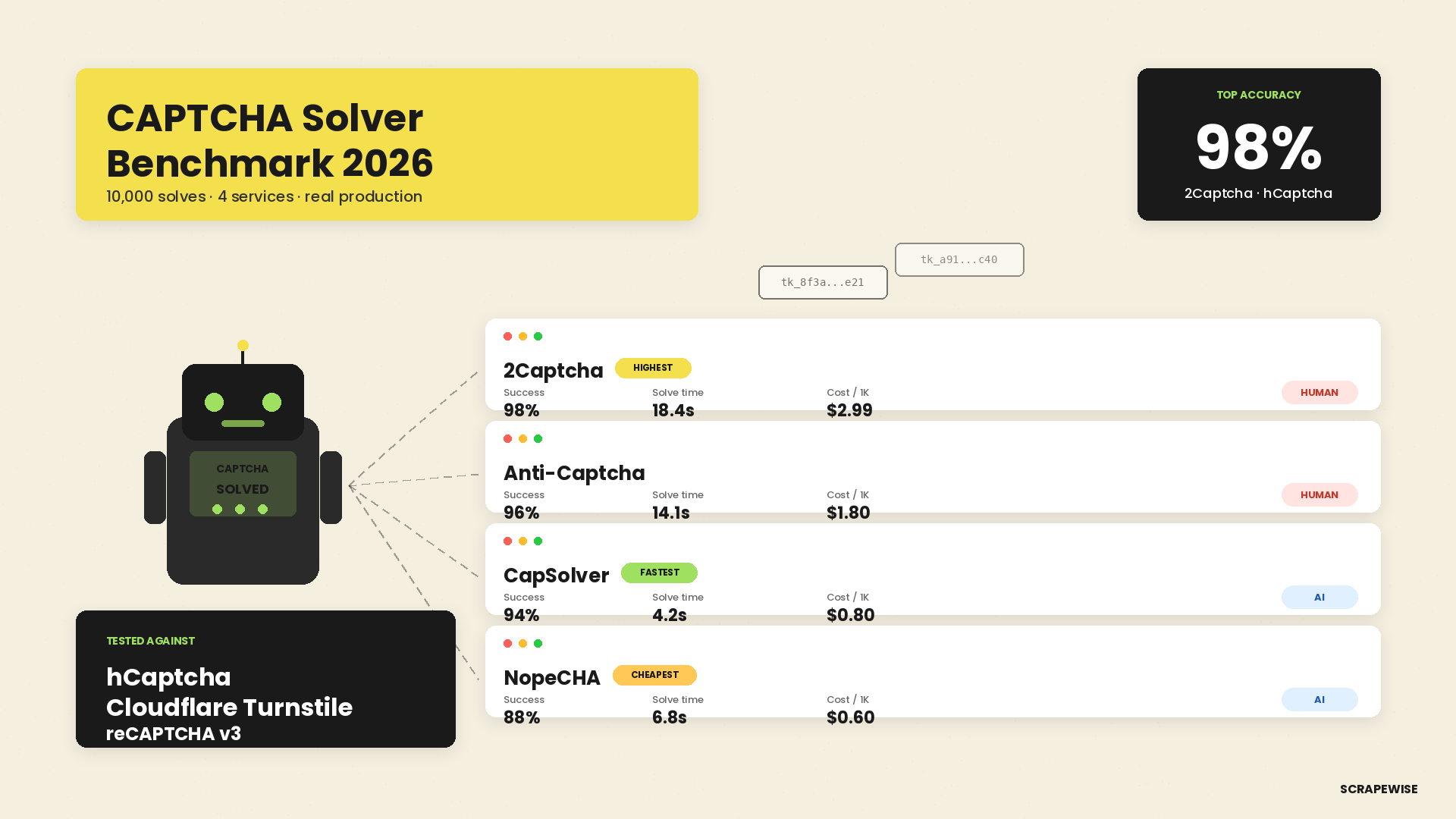
Four CAPTCHA solving services come up again and again for web scraping in 2026: 2Captcha, CapSolver, Anti-Captcha and NopeCHA. They differ in how they solve (AI, human workers, or both), how they charge, and which challenge types they list.
This guide compares them on what each vendor publishes, checked on their own sites in Nov 2026, and shows you how to test them on your own targets. That last part matters most. A vendor's "99% success rate" tells you how often it returns a token, not how often your target site accepts it.
ScrapeWise publishes this blog and sells a scraping service that handles challenges for you, so read the ScrapeWise section at the end with that in mind.
Skip the stealth setup: one API call. If you need the data rather than the scraper, send the page URL to the Scrapewise API and get structured rows back. Each page is fetched plain first and moved to a real browser or residential IPs only when it is blocked, so there is no wiring in a CAPTCHA solver on your side. Those rows can feed competitor price tracking, and self-serve can also match them to your own products from a product list you upload. Try it with 5 free requests, no card needed.
Why CAPTCHA Solving Is a Bottleneck in 2026
CAPTCHA difficulty increased sharply between 2024 and 2026. Cloudflare Turnstile rolled out broader enforcement across mid-market e-commerce sites. hCaptcha enterprise tiers became the default for financial data and marketplace platforms. Google reCAPTCHA v3 introduced adaptive scoring that adjusts based on browser fingerprint — not just token response.
The result: services that worked reliably in 2024 started failing silently. A CAPTCHA solver returning a valid token doesn't guarantee the target site accepts it. Token freshness, IP reputation, TLS fingerprint, and browser header consistency all feed into the challenge response.
For pricing teams tracking competitor catalogues across European retailers — where sites like Zalando, Bol.com, and Allegro all deploy JavaScript-rendered CAPTCHA challenges — a 5% failure rate at 100K daily requests means 5,000 missed data points per day. That compounds fast.
CAPTCHA solving isn't a one-time integration. It's ongoing infrastructure with a failure budget you need to manage.
For more on building a resilient anti-bot stack, see our guide on web scraping without getting blocked in 2026.
How to Test a CAPTCHA Solver on Your Own Targets
Published numbers are a starting point. The only figures that count are the ones from your own targets, so run a small trial before you commit:
- Pick the CAPTCHA types you actually meet: usually hCaptcha, Cloudflare Turnstile and reCAPTCHA v3 (score-based, no visible challenge).
- Send the same set of challenges to each service, a few hundred per type is enough to see a pattern.
- Keep the proxy pool, rotation policy and browser setup identical for every service, so the solver is the only thing that changes.
Then record four things per service and type:
- Accepted rate: the token was accepted by the target site, not just returned by the API
- Solve time: from API call to token returned, average and slowest 1%
- Cost per usable page: the price per 1,000, divided by the share of tokens that were accepted
- Timeouts: how often the API did not answer in time
Point 3 is the one people skip. A solver that costs half as much but fails twice as often can cost more per page you can actually use, once you count retries.
The Four Services Side by Side
| Service | How it solves (vendor's own description) | reCAPTCHA v2 per 1,000 | Turnstile per 1,000 | Pricing model |
|---|---|---|---|---|
| 2Captcha | AI first, verified human workers when AI confidence is low | $1 to $2.99 | $1.45 | Pay per solve |
| CapSolver | AI, fully automated | $0.80 | $1.20 | Pay per solve |
| Anti-Captcha | Human workers ("100% of captchas are solved by human workers") | $0.95 to $2 | $2 | Pay per solve, volume discounts |
| NopeCHA | AI, fully automated | Subscription | Subscription | Monthly plan with a daily quota, from $4.99 a month for 2,000 solves a day |
Prices and descriptions as published on each vendor's site, checked Nov 2026. Prices change, so check the vendor page before you budget.
The broad pattern: services that use human workers can handle odd challenges a model has not seen, and pay for it in speed on those tasks. Fully automated services answer faster and usually cost less per solve, and have no person to fall back on when a new challenge variant appears.
Which trade-off you can live with depends entirely on your workload.
2Captcha: AI First, Humans as Fallback
2Captcha's own site says most tasks are solved automatically by AI models for speed, and a task is passed to verified human workers when the AI is not confident. It lists a long set of supported types, including reCAPTCHA v2, v3 and Enterprise, Cloudflare Turnstile, Arkose Labs (FunCaptcha), GeeTest, DataDome and Amazon captcha.
The human fallback is the reason it stays on shortlists, and also its cost: tasks that reach a person take longer than tasks a model answers. For synchronous scraping workflows that block on CAPTCHA resolution, that slower tail is what to measure.
Pricing: $1 to $2.99 per 1,000 for reCAPTCHA v2 and $1.45 for Turnstile (checked Nov 2026), which puts it at the upper end of this group for reCAPTCHA v2.
Best for: Batch jobs where getting an answer matters more than throughput, and targets with unusual challenge types.
CapSolver: Fully Automated Speed
CapSolver describes itself as an AI-powered automatic CAPTCHA solver for reCAPTCHA, Cloudflare, AWS WAF, GeeTest and OCR. No human workers in the loop. Its pricing page lists response times under 5 seconds for reCAPTCHA v2 and under 3 seconds for reCAPTCHA v3 and Turnstile.
At $0.80 per 1,000 for reCAPTCHA v2 and $1.20 for Turnstile (checked Nov 2026), it is one of the cheaper pay-per-solve options here.
The trade-off is that a fully automated solver depends on its models keeping up with the challenge. CapSolver's own pricing page asks you to contact them if you cannot get a reCAPTCHA v3 score of 0.7 or 0.9, which is a fair hint that score-based challenges need checking on your own targets.
Best for: High-volume price monitoring, catalogue scraping and e-commerce data pipelines where you can re-queue failed requests.
Anti-Captcha: Human Workers, Published Price Bands
Anti-Captcha states that 100% of captchas are solved by human workers. Its published prices are $0.95 to $2 per 1,000 for reCAPTCHA v2 (with automatic volume discounts), $1 to $2 for reCAPTCHA v3 depending on the score, and $2 for Turnstile (checked Nov 2026).
A fully human service is the natural fallback when an automated solver struggles with a target, so it often sits second in a two-solver setup.
Best for: A fallback service for challenges your primary solver cannot handle, and teams that prefer a human-solved model.
NopeCHA: Subscription Instead of Pay per Solve
NopeCHA describes its service as fully automated via AI. It is the only one of the four sold as a subscription: plans run from $4.99 a month for 2,000 solves a day up to $99.99 a month for 200,000 solves a day, and a free plan allows up to 100 recognitions every 24 hours for personal or hobby projects (checked Nov 2026). Some types, including Cloudflare Turnstile in its recognition API, need its browser extension.
Because you pay for a daily quota, your real cost per solve depends on how much of the quota you use. A quota you fill every day is cheap per solve; a quota you rarely touch is not.
Best for: Development and testing, and steady daily workloads that fit a quota.
NopeCHA vs NoCaptchaAI vs FCB: Budget CAPTCHA Solvers Compared (2026)
These three are the low-cost end of the market. NopeCHA sells daily-quota subscriptions. NoCaptchaAI and FCB are pay-as-you-go APIs. None of them publishes a figure for how often target sites accept their tokens, so test them on your own targets before you commit.
| Feature | NopeCHA | NoCaptchaAI | FCB (Free CAPTCHA Bypass) |
|---|---|---|---|
| Solving method (vendor description) | AI, fully automated | AI models built for each CAPTCHA type | Not stated on the vendor site |
| CAPTCHA types (vendor-listed) | reCAPTCHA v2 and v3, hCaptcha, Cloudflare Turnstile, AWS WAF, FunCAPTCHA, GeeTest, Human (PerimeterX), text | hCaptcha, reCAPTCHA, Cloudflare Turnstile, GeeTest, AWS WAF, image to text (20+ types) | Image, reCAPTCHA v2, v3 and Enterprise, Cloudflare Turnstile, FunCAPTCHA, GeeTest, AWS WAF, DataDome slider |
| Pricing model | Subscription with a daily solve quota, from $4.99 a month for 2,000 solves a day; free plan of 100 recognitions a day for personal or hobby use | Pay as you go per 1,000 solves, from $0.14 (reCAPTCHA v2) to $0.50 (GeeTest v4 token) | Pay as you go: $0.20 per 1,000 for reCAPTCHA and Turnstile, $0.05 per 1,000 for image to text |
| Browser extension | Chrome, Firefox | Chrome, Firefox | Not listed on the vendor site |
NopeCHA and NoCaptchaAI details as listed on nopecha.com and docs.nocaptchaai.com, checked Nov 2026. FCB details as listed on freecaptchabypass.com in September 2026; we could not re-check that site in Nov 2026, so confirm its prices there before you rely on them.
How to read this: all three describe themselves as automated, and Cloudflare Turnstile is the type where automated solvers most often need extra setup, such as NopeCHA's browser extension. A low price per 1,000 also ignores failed tokens. A solver that costs half as much but fails twice as often on Turnstile can cost more per usable page once you count retries. For Turnstile-heavy targets, keep a human-solved fallback such as 2Captcha or Anti-Captcha.
Which Best CAPTCHA Solving Service Fits Your Scraping Stack?
The right answer depends on two variables: CAPTCHA type distribution on your targets, and throughput requirements.
Use this decision framework:
If your targets use Cloudflare Turnstile heavily: test an automated solver first, and keep 2Captcha or Anti-Captcha as a human-solved fallback. Tokens that are returned but rejected fail silently, and that compounds into data gaps at volume.
If you're running high-volume batch scrapes (100K+ daily requests): CapSolver or another fully automated service. Short response times keep concurrent pipelines moving. Build a retry queue for the tokens that fail, and size it from your own trial.
If you need predictable solve times: measure the slowest 1% of solves in your own trial, not the average. The average hides the outliers that break time-windowed crawls.
If you're prototyping: NopeCHA's free plan or $4.99 starter plan keeps costs low while you validate your scraping architecture.
For teams targeting European e-commerce — particularly sites running Cloudflare or Akamai at the CDN layer — our bypass guide for Cloudflare, Akamai, and PerimeterX covers the full anti-bot context that sits around CAPTCHA solving. CAPTCHA is one layer; fingerprinting and TLS profiling are the others.
If the CAPTCHAs are only in your way: it is worth asking whether solving them is your problem at all. When the objective is retail pricing rather than the pipeline itself, competitor price tracking delivers the dated price rows directly and the solver choice above stops being a line item you maintain.
Skip the Stack: Managed CAPTCHA Solving with Scrapewise
Building a reliable CAPTCHA solving pipeline means more than picking a service. You need:
- Fallback logic between services (CapSolver primary → 2Captcha on Turnstile fallback)
- Retry queues with exponential backoff
- Token freshness validation before use
- Proxy pool rotation that keeps IP reputation consistent with CAPTCHA tokens
That's infrastructure work on top of your actual scraping objective. If the data is the objective rather than the pipeline, the whole list collapses to:
# pip install scrapewise
from scrapewise import ScrapewiseClient

with ScrapewiseClient() as sw:  # reads SCRAPEWISE_API_KEY from the environment
    html = sw.load_site("https://www.example.com/product/123")
Scrapewise keeps challenge handling, proxy rotation and browser fingerprinting on its side, so you send a URL and get structured data back without running the anti-bot stack yourself. You pay per page: €0.15 to €3.75 per 1,000 depending on the page type. It does not reach every site: some block automated visits or need a login, and no tool covers every site. The same handling sits behind every call to the Scrapewise web scraping API, so the solver choice above stops being your decision to maintain. For pricing teams who need competitor data from CAPTCHA-protected catalogues, that's the operational argument for a service over DIY solver integration.
To see whether that holds for your own targets, run a few of your competitor URLs through ScrapeWise: the first 5 requests are free, no card needed.
Already have the URLs? Scrape a list of URLs in one run: upload the CSV and get back one clean row per link.
Skip the captcha solver
Paste the page that keeps throwing captchas. ScrapeWise runs the browser and proxies and gives you the data as a table. 5 free requests, no card.
Not ready to sign up? See 12 real Amazon rows, 972 columns →
5 free requests no credit card · from €0.15 per 1,000 pages · or call it from Python or MCP →