
Crawl4AI, Firecrawl, ScrapeGraphAI and browser-use have made agentic web scraping easy to try. Running it at production scale is a different matter. An LLM changes how data is extracted from a page, not how your browser looks to bot protection, and every page it reads costs tokens.
Agentic web scraping is genuinely powerful. But the hype has outrun the reality of running it at production scale. This guide breaks down what agentic web scraping AI agents can and can't do in 2026 — with the cost logic, the failure modes, and the architecture that actually works.
What Is Agentic Web Scraping?
Agentic web scraping uses autonomous LLM-driven agents to collect web data. Instead of following rigid CSS selectors or XPath rules, these systems decide their own next steps, adapt to unexpected page states, and extract information based on semantic meaning.
A traditional scraper says: "find the element with class .product-price and return its text." An agentic scraper says: "find the current price of this product, even if the layout has changed, the price loads via AJAX, or you need to click 'show price' first."
This is distinct from AI-powered web scraping, which layers ML on top of traditional selector-based scrapers. Agentic systems replace the scripting layer entirely with an autonomous reasoning loop.
Four widely used open frameworks (repository details checked Nov 2026):
- Crawl4AI: open-source crawler and scraper (Apache 2.0) that turns websites into LLM-ready Markdown
- Firecrawl: web data for AI agents, open source under AGPL-3.0 with a hosted service
- ScrapeGraphAI: Python library (MIT) using LLM-driven graph pipelines for extraction
- browser-use: Python library (MIT) that lets an AI agent drive a real browser
Each takes a different approach to the same problem: how do you extract structured data from the web reliably, without maintaining fragile selector schemas?
Agentic vs Traditional vs Managed API: How They Compare
| Factor | Traditional Scraper | AI Agent | Managed API |
|---|---|---|---|
| Setup time | Hours to days | Minutes | Minutes |
| Cost driver per page | Your proxies and compute | LLM tokens on every page, plus proxies and compute | Provider's per-page price |
| Throughput | High | Limited by LLM response time | High |
| Handles layout changes | Breaks until fixed | Adapts, but can misread | Provider maintains fetching; you still check output |
| Unstructured data extraction | Manual schema | Natural language | Depends on provider |
| Maintenance burden | High | Low to medium | Low |
The key point: LLMs don't change how your browser fingerprint looks to Cloudflare. Bot protection looks at signals such as the TLS handshake; Cloudflare's own docs describe JA3 and JA4 fingerprints that identify TLS clients by how they start a connection. An agent running through a standard headless Chromium instance presents the same signals as any other headless browser, and LLM-driven browsing patterns (direct navigation to target elements, irregular timing, missing scroll events) can make it easier to spot, not harder. Whether an agent gets through depends on fingerprinting and proxy setup, not on the intelligence of the extraction layer.
Cost works the same way. A traditional scraper parses a page with selectors at almost no marginal cost. An agent sends every page through an LLM, so token cost grows in a straight line with page count, on top of proxy, compute and storage. At small volumes nobody notices. At a million pages a month it becomes the biggest line on the bill.
Where AI Agents Genuinely Win
Agents outperform traditional scrapers in four scenarios:
Unstructured data extraction. When data doesn't map cleanly to a predictable CSS class — product specs embedded in descriptions, review summaries, multi-step PDPs with conditional content — natural language extraction outperforms manual schema engineering. This is the primary use case for product data extraction on complex catalogue pages.
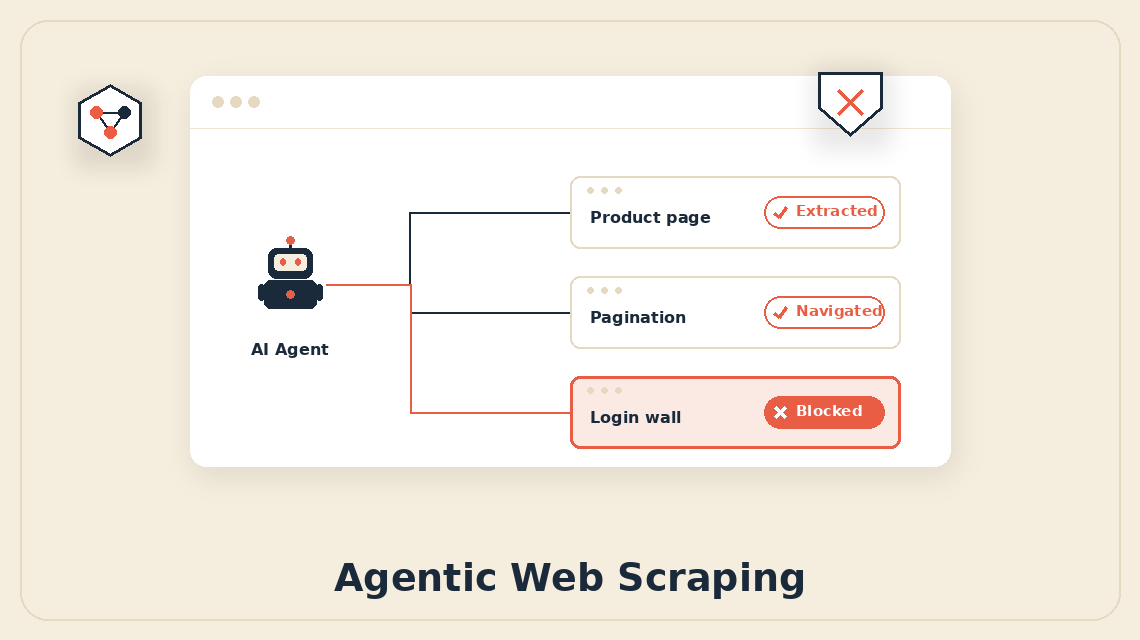
Dynamic navigation flows. Agents handle multi-step interactions that break traditional scrapers: login walls, cookie consent flows, "load more" pagination, AJAX tabs, and product configurators with conditional variants. For a PDP where you need to select size → colour → configuration before a price renders, an agent navigates the flow autonomously rather than requiring brittle Playwright orchestration for every variant.
Schema-free exploration. When you don't know the data structure of a new site in advance, an agent explores and returns a reasonable schema without pre-coding. Crawl4AI's autonomous schema generator is the production-ready version of this: describe what you want in plain English, get structured JSON back.
Small-scale research tasks. For research jobs of a few hundred pages — competitive landscape analysis, ad copy collection, SERP monitoring — agents are fast to deploy and the LLM token cost is manageable. The economics only break at scale.
Where AI Agents Fail in Production
Anti-bot detection is the critical gap. Modern bot protection evaluates TLS fingerprint, browser API inconsistencies, mouse movement patterns, request timing, and header entropy. LLMs don't influence any of these signals. Our guide to getting past Cloudflare, Akamai and PerimeterX covers what those systems check. Without proper fingerprinting and residential proxies, you're paying LLM inference costs on jobs that fail before extraction begins.
Cost at scale breaks the economics. At a million or more pages a month, LLM inference dominates the cost structure, even with a small, cheap model. Every page carries a token cost on top of proxy, compute and storage, and that cost does not shrink with volume the way fixed scraper costs do.
Consistency fails where accuracy matters. Agents can produce output that is structurally valid but wrong: the wrong price tier, a misidentified variant, or a field made up from surrounding text that isn't on the page at all. For competitor price tracking, where margin decisions depend on the output, any error rate without automated validation is a problem, so check extracted prices against the page before you trust them.
Speed constraints prevent high-frequency use cases. LLM inference adds seconds of latency to every page, and an agent that clicks through a flow adds more. That makes agents a poor fit for large, frequent crawls such as daily pricing runs across big catalogues or high-frequency brand monitoring.
The Architecture That Actually Works
The teams getting real production value from agentic scraping in 2026 layer agents on top of managed infrastructure — they don't replace the infrastructure layer with agents:
[AI Agent Layer]         — Natural language instructions, schema discovery,
                           multi-step navigation, semantic extraction logic
         ↓
[Managed Data Layer]     — Anti-bot bypass, residential proxy rotation,
                           TLS fingerprinting, rate limiting, retry logic
         ↓
[Structured Output]      — Validated JSON delivered to your data pipeline
The agent defines what to extract and how to navigate. The managed infrastructure handles getting past bot protection, rotating IPs, and managing request timing. Our post on self-healing scraper infrastructure goes into how teams split that work: fetching problems stay in the infrastructure layer, and the agent only deals with what the page means.
In practice: if you're running Crawl4AI or browser-use against any protected e-commerce target, you need a managed proxy layer with residential IPs and proper fingerprinting between your agent and the target. Without it, you pay LLM inference costs on jobs that fail at the WAF.
Agentic Scraping in European E-Commerce Markets
European e-commerce targets present specific challenges for agentic frameworks. GDPR consent modals — mandatory across EU markets — add an interaction step before any data extraction. Consent tools such as OneTrust and Quantcast come in many variants, and an agent has to recognise and dismiss each one. A purpose-built consent handler for a known site is usually more reliable than asking the agent to work it out every time.
The EU Digital Services Act also creates new data transparency requirements for large platforms operating in European markets — potentially changing how product and pricing data is structured on major marketplaces. Teams monitoring European pricing data should factor DSA-driven access policy changes into their 2026 data architecture planning.
Language diversity adds a further layer: Nordic and DACH retailers (Verkkokauppa, MediaMarkt, Coolblue) often render prices, availability, and variant labels in local languages with locale-specific formatting. LLM-based extraction handles multilingual PDPs significantly better than regex-based selectors — one area where the agent layer adds genuine value regardless of scale.
What to Use When
| Scenario | Recommended Approach |
|---|---|
| Research tasks, under 500 pages | Agents alone |
| Complex navigation, unprotected sites | Agents + basic proxy |
| Protected sites, up to 50K pages/month | Agents + managed infrastructure |
| Production pricing surveillance | Managed API + agent post-processing |
| High-frequency, high-volume pipelines | Traditional scraper + managed infra |
Agentic web scraping AI agents are a genuine step forward for extraction flexibility. The limitation isn't the intelligence layer — it's the infrastructure underneath. Anti-bot bypass, proxy management, fingerprinting, and retry logic remain the hard problems, and LLMs don't solve them.
ScrapeWise, which publishes this blog, can sit in that infrastructure layer. You send URLs, it fetches the pages and returns rows as a table, CSV/Excel, through the API, or through an MCP server your agent can call directly. You pay per page, from €0.15 per 1,000 plain pages to €3.75 for pages that need a browser and residential IPs. Scheduled runs go at most once a day, plus manual runs, so it suits daily pricing data rather than intraday monitoring. Some sites block automated visits or need a login, and no tool covers every site. The use-case page on web data extraction for AI agents and LLM pipelines covers the schema-constrained output format: typed records where every field carries its source URL and timestamp, and a field the page never published stays null instead of becoming a plausible guess.
If you're wiring an agent to protected product pages, try your own target URLs first: the first 5 requests are free, no card needed.
Paste a URL that blocks your scraper
Browser rendering and residential proxies are built in. No proxies to manage, pay per page from €0.15 per 1,000.
Not ready to sign up? See 12 real Amazon rows, 972 columns →
5 free requests no credit card · from €0.15 per 1,000 pages · or call it from Python or MCP →